
B2B SaaS Discounting Strategy: Protect Margins and Deal Velocity
Uncontrolled discounting destroys ACV and trains buyers to undervalue your software. Here is a battle-tested discounting matrix and negotiation framework for SaaS founders.
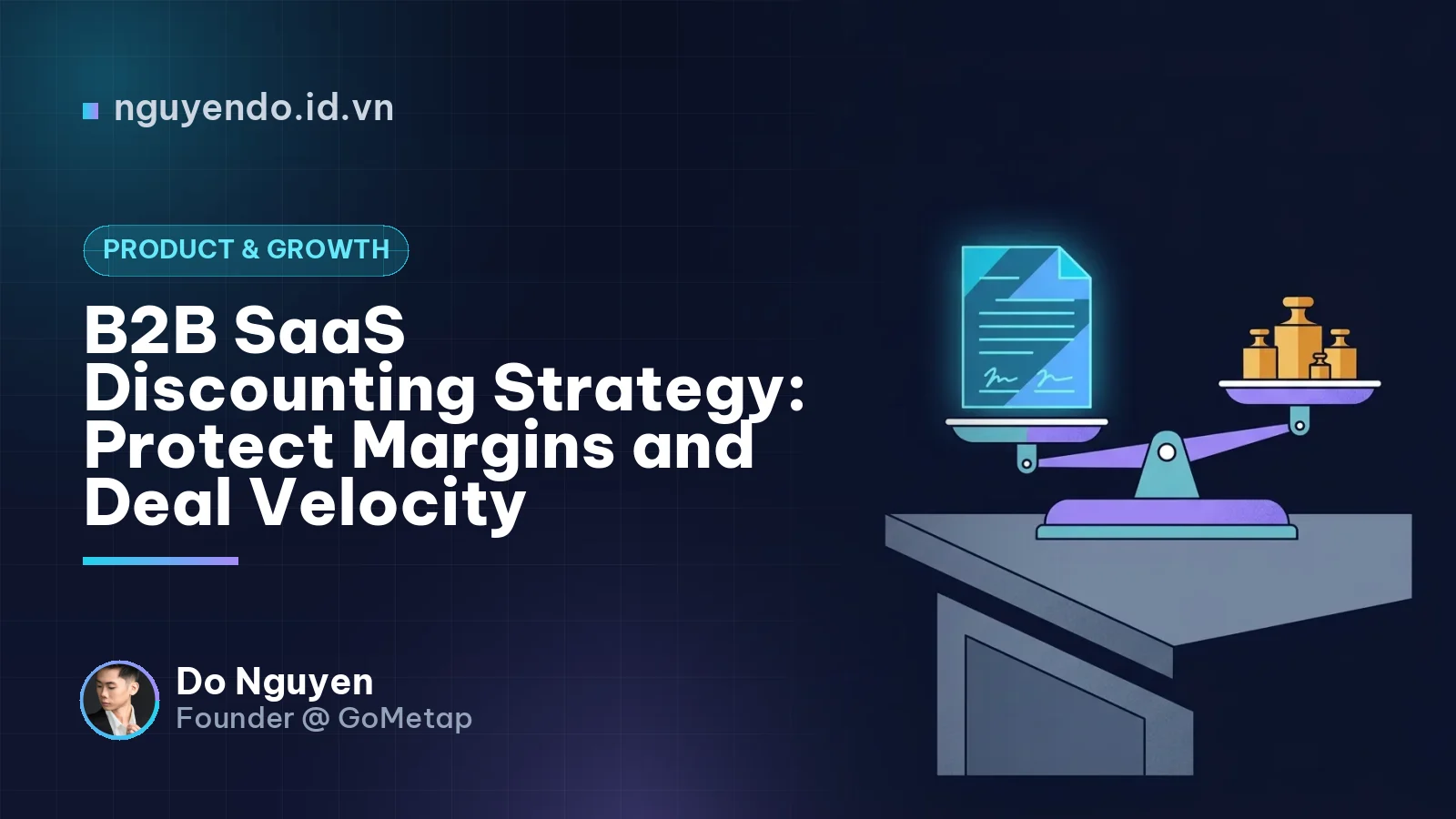
Table of contents
- The True Cost of SaaS Discounting
- The Golden Rule: Never Concede on Price Without a Trade
- The SaaS Discounting Matrix
- 4 Alternatives to Dropping Your SaaS Subscription Price
- 1. Waive One-Time Implementation or Migration Fees
- 2. Include Tier Upgrades on a Temporary Basis
- 3. Offer Delayed Invoicing Tied to Implementation
- 4. Provide Additional Seat or Usage Allowances
- How to Respond to Common Pricing Objections
- Objection: "Your competitor is 30% cheaper."
- Objection: "We only have budget for $8,000, not your $10,000 quote."
- Standardizing the Discount Policy Inside Your Organization
A disciplined B2B SaaS discounting strategy preserves profit margins, accelerates deal cycles, and prevents early-stage software companies from establishing dangerous pricing precedents. Instead of treating price concessions as a default closing tactic, sustainable SaaS organizations use discounting as an intentional trade mechanism: every reduction in price must yield an equivalent gain in cash velocity, contract commitment, or marketing leverage.
For founders building across Southeast Asia and scaling into global markets, the pressure to discount is intense. Regional buyers are notoriously price-sensitive, and international prospects often attempt to leverage their geographical advantage to demand steep concessions. Giving in too quickly does not merely cost revenue; it signals weak product conviction and attracts customers who rarely retain.
The True Cost of SaaS Discounting
A SaaS discount policy is a documented set of rules establishing the maximum allowable price reductions, necessary commercial trade-offs, and approval workflows required to close a contract.
When a sales representative offers a 25% discount to close an enterprise account by the end of the month, the downstream impact extends far beyond that single invoice.
- Multiple compression: Enterprise software companies are valued on recurring revenue multiples. Discounting your Annual Recurring Revenue (ARR) directly reduces your balance-sheet valuation.
- The renewal trap: When an account renews twelve months later, lifting their price back to list rates is notoriously difficult. The customer treats the discounted rate as the true baseline, turning the renewal conversation into a hostile renegotiation.
- Increased churn risk: Data consistently shows that heavily discounted B2B accounts churn at higher rates than full-price cohorts. When a customer pays pennies on the dollar, their internal adoption urgency drops, leading to poor implementation and eventual cancellation.
The Golden Rule: Never Concede on Price Without a Trade
If you drop your price without asking for anything in return, you validate the prospect's belief that your initial pricing was arbitrary or inflated. Every discount request must be met with a quid-pro-quo demand that serves your balance sheet or operational roadmap.
Here are five high-value concessions you should demand in exchange for a lower subscription fee:
- Annual upfront payment: Swap a monthly billing arrangement for 100% upfront payment within 14 days, securing non-dilutive working capital.
- Multi-year commitment: Offer a minor recurring discount in exchange for a locked two-year or three-year agreement with mutual termination for cause only.
- Case study and logo rights: Require the client to commit to a named case study, video testimonial, and public quote within 60 days of successful onboarding.
- Compressed evaluation timeline: Condition the discount on signing by a specific date, eliminating prolonged decision fatigue.
- Reduced service levels or feature tiering: If a customer insists on paying 20% less, remove 20% of the value by stripping out dedicated account management, custom onboarding, or advanced integrations.
The SaaS Discounting Matrix
To eliminate arbitrary decision-making, establish a clear discounting matrix. This provides your team with strict guardrails while giving them enough tactical autonomy to maintain momentum.
| Discount Percentage | Required Customer Concession | Approval Level Required |
|---|---|---|
| 5% – 10% | Annual upfront prepayment (no monthly terms) | Account Executive / Sales Lead |
| 11% – 15% | Two-year contract + written case study commitment | VP of Sales / Commercial Director |
| 16% – 20% | 3-year contract + upfront billing + quarterly reference calls | Founder / CEO |
| > 20% | Strategic design partner agreement (joint IP, public press release) | Board or Executive Committee |
At GoMetap, when designing commercial structures for enterprise merchants adopting our O2O and digital membership platforms, we apply this exact trade-off discipline. If a large retail brand requests preferential tier pricing on payment routing or Apple Wallet pass infrastructure, we tie those rates to multi-location rollouts or multi-year operational exclusivity rather than eroding our platform margins unconditionally.
4 Alternatives to Dropping Your SaaS Subscription Price
Before slashing recurring software fees, deploy non-recurring concessions that protect your baseline Annual Contract Value (ACV).
Annual Contract Value (ACV) is the average annualized revenue generated by a single customer subscription contract.
1. Waive One-Time Implementation or Migration Fees
Waiving a professional services fee costs internal hours, but it leaves your ongoing recurring license fee pristine. Your recurring revenue baseline remains intact, ensuring future renewal and expansion multiples remain uncompromised.
2. Include Tier Upgrades on a Temporary Basis
Instead of discounting a $500/month tier down to $400, give the buyer access to your $750/month tier for the standard $500 rate for the first year. This introduces the customer to advanced capabilities, creating high switching costs and a natural upsell pathway when the renewal period arrives.
3. Offer Delayed Invoicing Tied to Implementation
If a prospect cites budget friction in their current quarter, offer a standard-rate annual agreement that delays the initial invoice by 45 to 60 days. This allows them to complete onboarding and see time-to-value before the cash leaves their account, solving their immediate internal cash-flow constraint without lowering your software price.
4. Provide Additional Seat or Usage Allowances
In seat-based or consumption-based SaaS models, granting additional seat headroom costs negligible marginal dollars while making the product more deeply embedded across the buyer's organization.
How to Respond to Common Pricing Objections
Objection: "Your competitor is 30% cheaper."
- Bad response: "We can match their price if you sign this week."
- Strategic response: "They are cheaper for a reason. Most of our current customers evaluated them before switching to us because our platform handles multi-branch inventory reconciliation without manual sync errors. If basic functionality is all your team needs right now, they may be a fit. But if you want to avoid rebuilding your workflows in six months, our pricing reflects that reliability. Can we review where their workflow breaks down for your use case?"
Objection: "We only have budget for $8,000, not your $10,000 quote."
- Bad response: "I talked to my founder, and we can do $8,000 for you."
- Strategic response: "We can accommodate an $8,000 budget by adjusting the scope. If we move from our dedicated Slack support tier to standard email support and limit the initial deployment to your primary operating unit, we can hit that exact figure. We can add the remaining modules next quarter once you see the initial ROI. Does that work for your team?"
Standardizing the Discount Policy Inside Your Organization
Enforcing pricing discipline requires formal operational guardrails:
- Configure your CRM: Ensure your CPQ (Configure, Price, Quote) or CRM tools block sales reps from generating order forms with unapproved discounts.
- Audit closed-won cohorts: Run quarterly cohort analyses tracking the gross churn, net retention, and support ticket volume of discounted accounts versus full-price accounts.
- Compensate on margin, not just volume: If sales reps are compensated purely on top-line deal volume, they will naturally discount to remove closing friction. Align compensation by penalizing commission percentages proportionally whenever a deal requires pricing concessions.
Pricing integrity is ultimately an indicator of product-market fit. When you stop treating discounts as a crutch, your team learns to sell real business impact—building a healthier, more resilient SaaS business in the process.

Comments
No comments yet. Be the first to share your thoughts!