
Building a Product Ecosystem for B2B SaaS
When should a B2B SaaS startup transition from a single product to an ecosystem? A mental framework to help founders expand without diluting resources.
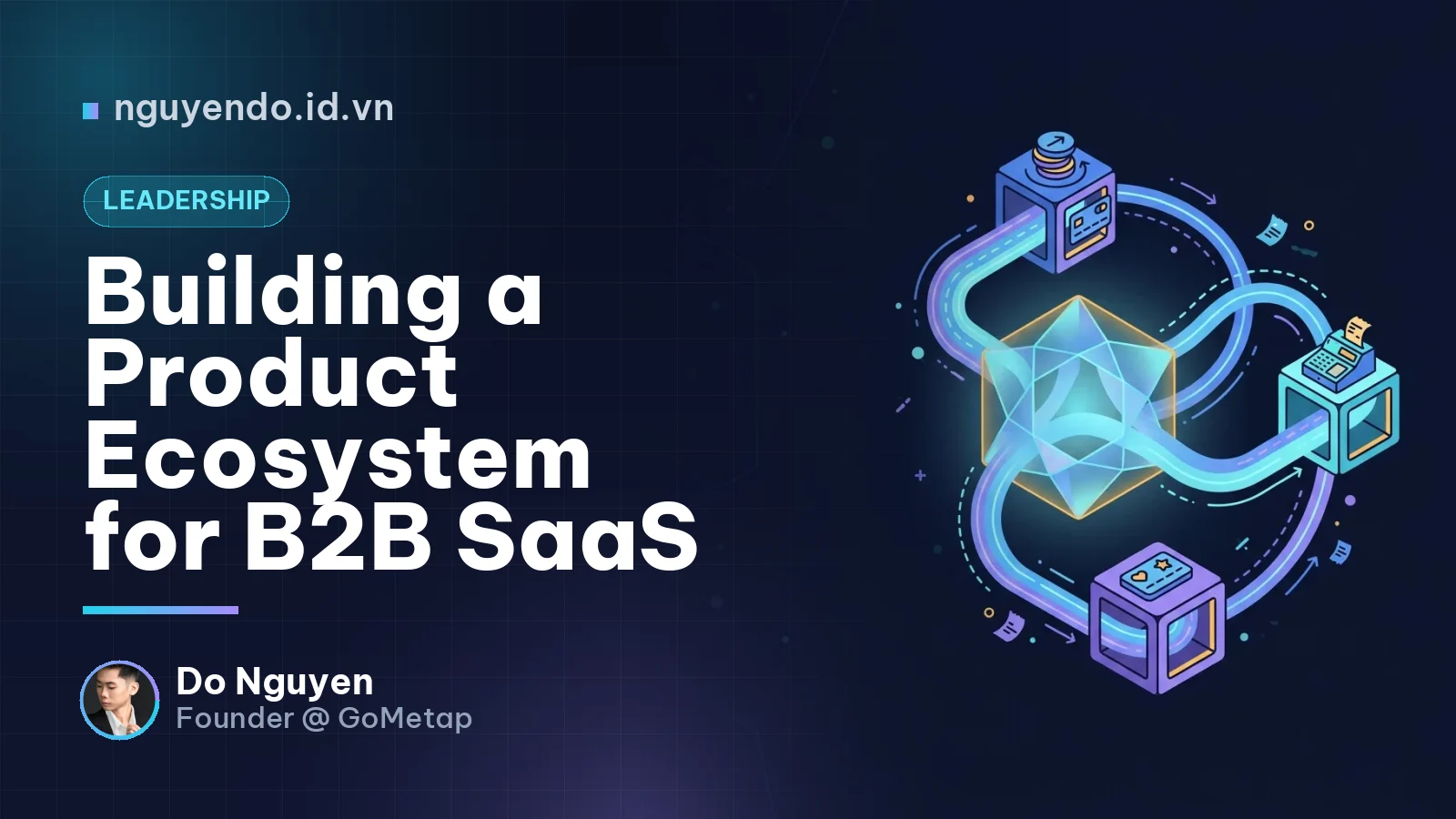
Table of contents
- What Is a Product Ecosystem in B2B SaaS?
- Why Do Many Startups Fail When Trying to Build an Ecosystem Too Early?
- The Wedge Strategy: The Starting Point of Every Ecosystem
- An Expansion Framework: Follow the Data Flow and Customer Journey
- 4 Signs You Are Ready to Build Your Second Product
- 1. The Core Product Operates Predictably
- 2. Strong Pull from Existing Customers (Customer Pull)
- 3. Leveraging Existing Data Assets
- 4. Zero Added Friction for New Users
- Leadership Discipline in Managing a Multi-Product Model
- Summary and 3 Self-Reflection Questions for Founders
Building a product ecosystem in B2B SaaS is a growth strategy that evolves a tool from solving an isolated problem into an interconnected network of solutions sharing a unified data flow to serve an enterprise's end-to-end operations. For startups targeting the SME market in Vietnam, transitioning from a single-product to a multi-product model not only boosts customer lifetime value (LTV) but also creates a formidable competitive moat. However, expanding prematurely before the core product is sufficiently resilient easily traps businesses in resource dilution, yielding a half-baked software suite.
Having directly built technology solutions for small and medium-sized enterprises, I have observed that the line between a "true ecosystem" and a "bloated mess of features" is razor-thin. This article shares a mental framework to help B2B SaaS founders decide when and how to scale their product portfolio with discipline.
What Is a Product Ecosystem in B2B SaaS?
A Product Ecosystem is a collection of software products or modules capable of operating independently, yet when combined, automatically synchronize data to create compounding value far greater than the sum of their individual parts.
In SME-focused B2B software, we typically see two primary approaches:
- Point Solution: Focuses on executing a single operational step exceptionally well (for example, standalone accounting software, or a dedicated customer messaging tool).
- Product Ecosystem / All-in-one: Covers multiple adjacent touchpoints across the customer's operational chain.
In mature markets, an SME might run 5–7 different software tools and glue them together via integration platforms like Zapier. In Vietnam, however, most small business owners lack dedicated IT teams and are reluctant to pay for multiple separate subscriptions. They demand seamlessness, simplicity, and a single point of management. That is why the ecosystem model holds immense appeal in domestic markets.
| Criteria | Point Solution | Product Ecosystem |
|---|---|---|
| Core Objective | Deeply solve a specific pain point | Optimize entire adjacent workflows |
| Time-to-market | Fast, easy to test and pivot | Requires time to build foundation and architecture |
| Switching Cost | Low, easy to replace with alternative tools | Extremely high as data is deeply embedded across workflows |
| Biggest Risk for Startups | Capped revenue ceiling (small TAM), easily cloned | Spreading too thin without mastering any single product |
Why Do Many Startups Fail When Trying to Build an Ecosystem Too Early?
Many founders launch with an overly ambitious architectural blueprint: they want to build a POS, expand straight into an ERP, integrate a CRM, and tack on an e-commerce marketplace alongside HR management tools. The typical outcome after 12 months of burning cash is a bloated product plagued by persistent bugs, leaving customers confused about what the software actually does best.
This failure generally stems from three core missteps:
- Fragmented team focus: A lean engineering team (fewer than 10 people) cannot simultaneously optimize experiences for front-counter cashiers, back-office accountants, and marketing staff.
- Excessive market education costs: Pitching an overwhelming solution to an SME extends onboarding from a few days to several months. Smaller clients often churn before ever realizing the software's value.
- Lack of Data Gravity: An ecosystem only makes sense when Module A generates the data that fuels Module B. If neither module has consistent, active users, connecting them is meaningless.
The Wedge Strategy: The Starting Point of Every Ecosystem
A Wedge Strategy is a market penetration method where you lead with a small, lightweight product that instantly solves an urgent pain point to win customer trust before cross-selling more complex solutions.
Instead of erecting an entire fortress upfront, build an inviting, frictionless front door. An effective wedge product for SMEs must meet three criteria:
- Ultra-short Time-to-Value: Customers can set it up and realize measurable results within hours or days.
- High usage frequency: The product must live within the company's daily workflow, where operational source data originates.
- Acts as a data capture engine: From this initial touchpoint, you capture critical transactional or customer data to serve as a springboard for future expansion.
Take a hypothetical boutique day spa: The owner might hesitate to overhaul their legacy, manual appointment scheduling and technician payroll system. However, if you offer a frictionless tool allowing customers to scan dynamic QR codes at the counter and instantly save a digital loyalty card to Apple Wallet or Google Wallet, adoption resistance drops dramatically. That is your wedge product.
An Expansion Framework: Follow the Data Flow and Customer Journey
Once your wedge product gains traction, how do you decide which piece of the ecosystem to build next? The answer lies not in watching competitors, but in tracing the natural Data Flow.
Ask yourself: Immediately before and after a customer interacts with your product, what manual task must they perform?
At GoMetap, when shaping an O2O ecosystem for SMEs, our product philosophy avoids arbitrary feature-stuffing; it mirrors the actual in-store transaction journey:
- Touchpoint 1 – Sales Operations (POS): Fast, error-free order entry.
- Touchpoint 2 – Automated Payments: The moment an order registers on the POS, the payable amount automatically transforms into a dynamic payment code with instant reconciliation, eliminating manual transaction screenshots.
- Touchpoint 3 – Retention: Upon successful payment, that data stream immediately triggers points accrual, tier upgrades, or push offers directly inside the customer's digital pass on Apple Wallet & Google Wallet—without forcing them to download a dedicated app.
Notice the synergy: Orders generate Payments; Payments identify Customers; Customer data fuels Loyalty; and Loyalty drives repeat visits, generating new Orders on the POS. A closed-loop flywheel emerges naturally.
Separately, each component remains functional on its own. Together, they eliminate hours of manual reconciliation and erase communication lag in customer engagement.
4 Signs You Are Ready to Build Your Second Product
Committing capital and engineering bandwidth to an adjacent module or product is a pivotal strategic decision for a CEO. Never expand simply because the core offering feels "boring." Only greenlight expansion when these four signals emerge:
1. The Core Product Operates Predictably
Churn rate on the flagship product is consistently low and stable. Engineering is no longer firefighting fundamental architectural flaws, and sales and support playbooks are thoroughly standardized.
2. Strong Pull from Existing Customers (Customer Pull)
Customers frequently ask: "Do you offer module X? We want everything in one dashboard. Exporting Excel sheets from your platform just to import them elsewhere is exhausting." When multiple clients offer to prepay or commit to contracts if you build an adjacent feature, market validation is clear.
3. Leveraging Existing Data Assets
The second product should reuse at least 50% of the data generated by the first. If the new tool forces clients to configure everything from scratch and targets an entirely different internal persona, you are building a new startup, not an ecosystem.
4. Zero Added Friction for New Users
This presents a major Product Design challenge. When introducing second and third products, does your interface become overwhelming for a brand-new customer who only signed up for the initial tool? A resilient ecosystem architecture relies on modularity: interface complexity should only reveal itself as the customer's usage matures.
Leadership Discipline in Managing a Multi-Product Model
Evolving into a multi-product ecosystem company demands a fundamental shift in executive mindset:
- Think like an "Architect," not just a "Builder": In early stages, founders solve localized tactical problems. Scaling an ecosystem requires stepping back to design unifying standards: Single Sign-On (SSO), standardized customer data schemas, and a coherent design system.
- Prune underperforming branches decisively: Not every module added to an ecosystem will succeed. Some will suffer from persistently low adoption rates. True leadership discipline means having the courage to sunset underperforming add-ons to safeguard system simplicity.
- Price for synergy: Rather than mechanically stacking individual module fees, package cohesive solution bundles that demonstrate clear operational savings when clients consolidate their workflow onto your platform.
Summary and 3 Self-Reflection Questions for Founders
Building a B2B SaaS product ecosystem for SMEs is a marathon. It demands the patience to master small interactions before executing sweeping visions. When your product pieces snap cleanly into place and free your customers from manual operational drag, the software sells itself through organic retention.
Before writing the first line of code for the next piece in your ecosystem, reflect on these three questions:
- What is the true "wedge product" earning trust and proprietary source data today, and have you perfected its execution?
- If you launched a second product tomorrow, what data flow from the first product would automate at least 50% of the customer's manual work?
- Are you building this next piece because customers are genuinely demanding unified continuity, or simply because your team fears falling behind a competitor's feature checklist?

Comments
No comments yet. Be the first to share your thoughts!