
Designing Silver, Gold, and Diamond Tiers to Drive Upgrades
How to design an effective tiered membership program combining financial perks and exclusive experiences to motivate customers to spend and level up.
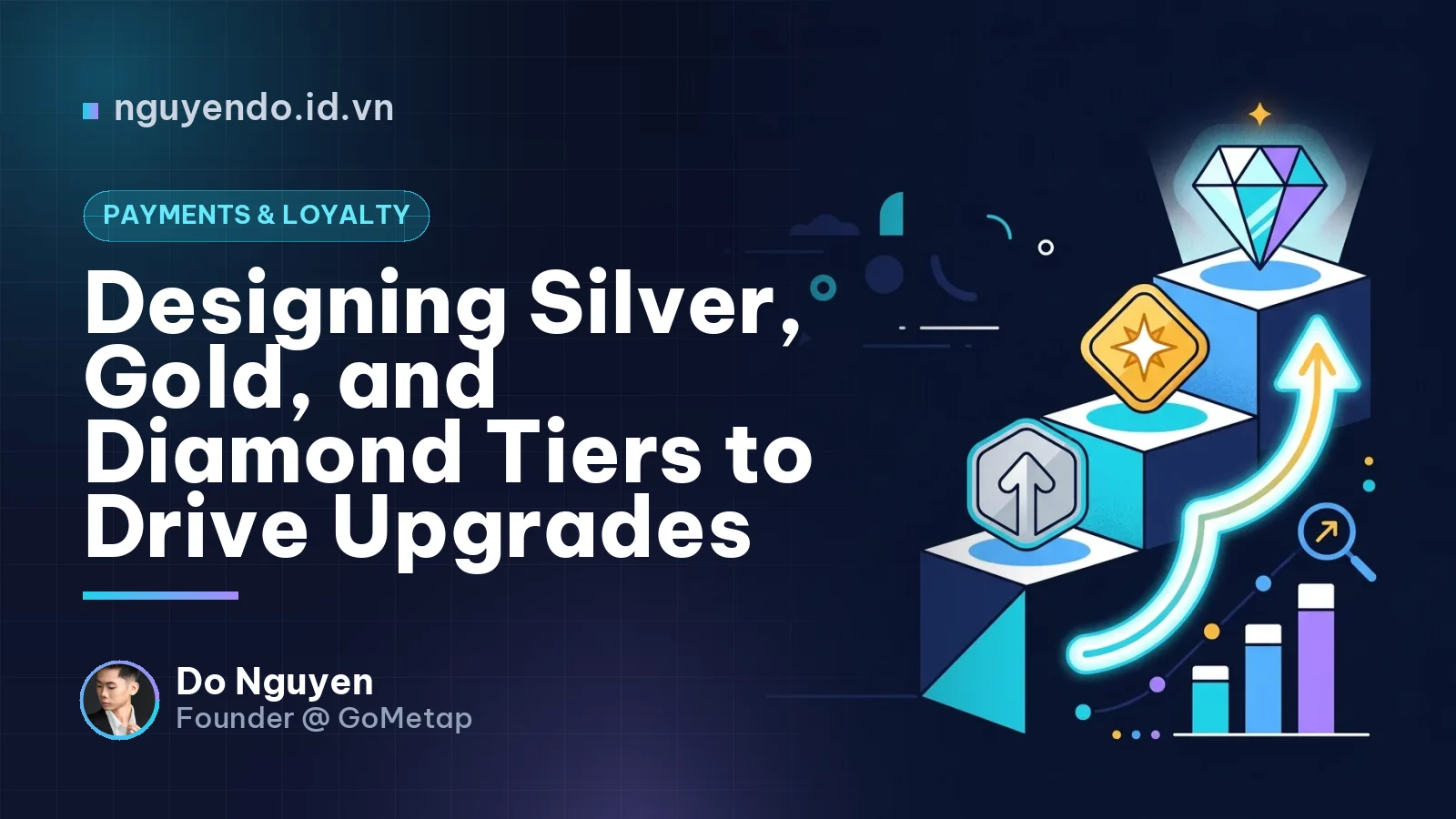
Table of contents
- Core Concepts Defined
- Why Customers Are Indifferent to Leveling Up
- 4 Principles for Designing Tiers That Drive Upgrades
- 1. Data-Driven, Not Intuition-Based
- 2. Meaningful Differentiation Between Tiers
- 3. Combine Financial and Experiential Benefits
- 4. Constant Presence at Customers' Fingertips
- Sample Matrix: Tier Structure for F&B and Retail
- Protecting Profit Margins
- Digitizing the Upgrade Experience with Apple Wallet and Google Wallet
- Handling Tier Maintenance and Downgrades Gracefully
- Conclusion
Designing successful Silver, Gold, and Diamond tiers requires businesses to build a clear value roadmap where the perks of the next tier clearly outweigh the cost and effort involved. Instead of merely offering meager, indistinguishable discounts, an effective program must skillfully combine financial benefits with exclusive experiences. When customers clearly see what they will gain and perceive the tier gap as achievable, they will naturally increase their purchase frequency and basket size to reach that milestone.
In this article, we'll explore how to structure membership tiers, protect profit margins, and leverage technology to turn leveling up into a seamless experience.
Core Concepts Defined
To build an effective program, we must establish standard terminology commonly used in CRM (Customer Relationship Management) platforms:
- Membership Tier: A specific level within a loyalty program where customers unlock benefits aligned with their spending or engagement levels.
- Tier Gap: The difference in points or spending that a customer must bridge to move from their current tier to the next higher one.
- Perceived Value: The worth a customer believes they receive from a perk or reward relative to the effort and money spent to earn it.
- Downgrade: An automated mechanism that demotes a customer's tier status when they fail to meet the required spending threshold within a specific timeframe.
Why Customers Are Indifferent to Leveling Up
Many business owners launch membership programs only to find customers making zero effort to reach higher tiers. From an operational perspective, this usually stems from three main causes:
- Unrealistic milestones: For example, a coffee shop with an average order value (AOV) of 50,000 VND requiring 10,000,000 VND in cumulative spend (equivalent to 200 cups) to reach Gold status. This discourages customers from day one.
- Uninspiring perks: Silver gets a 5% discount, Gold gets 7%. A 2% difference (worth just 1,000 VND on a 50,000 VND beverage) is nowhere near enough to create significant Perceived Value.
- Program invisibility: Customers don't know their current tier or how many points they need to upgrade. If they can't visualize their progress, they have no incentive to act.
4 Principles for Designing Tiers That Drive Upgrades
To address these pitfalls, apply the following four principles when structuring your business's tier system.
1. Data-Driven, Not Intuition-Based
Tier gaps must be calculated using real customer data. A solid rule of thumb is to design the program so that roughly 20–30% of customers can easily reach Silver after 2–3 purchases, 5–10% of regular customers achieve Gold, and only the top 1–2% of the most loyal reach Diamond.
- Example: If an average customer visits once a month with a 200,000 VND ticket, set Silver at 1,000,000 VND (after 5 visits). Position Gold at 3,000,000 VND and Diamond at 10,000,000 VND within a 1-year window.
2. Meaningful Differentiation Between Tiers
Instead of merely nudging discount percentages (5% - 7% - 10%), structure your tiers so that higher levels unlock entirely new categories of perks. High-tier customers don't just want to save a few extra dollars—they want to feel special.
3. Combine Financial and Experiential Benefits
Financial benefits (discounts, cashback, free items) attract customers initially. Experiential and emotional benefits (recognition, priority access, exclusivity) are what retain them long-term.
- Financial benefits: 1.5x points accumulation, free shipping, birthday gifts.
- Emotional benefits: Skip-the-line privileges, a dedicated support rep, early access to new products before public launch, or a secret menu exclusively for Diamond members.
4. Constant Presence at Customers' Fingertips
This is where technology proves essential. Nobody wants to carry a bulky wallet stuffed with plastic cards. Integrating digital membership passes directly into smartphones keeps customers constantly reminded of their status and progress.
Sample Matrix: Tier Structure for F&B and Retail
Here is a sample framework you can adapt for your SME business:
| Membership Tier | Qualification | Hard Perks (Financial Benefits) | Soft Perks (Experiential / Emotional) |
|---|---|---|---|
| New Member | Account registration (First purchase) | Earn 1 point per 100k spend. | None. |
| Silver | Accumulate 10 points (1M spend) | Earn 1.5 points / 100k. 50k e-voucher during birthday month. | None. |
| Gold | Accumulate 30 points (3M spend) | 2x points. 5% instant discount on total bill. Free upsize / Free delivery. | Skip-the-line payment. Free tastings of new items 3 days before official launch. |
| Diamond | Accumulate 100 points (10M spend) | 3x points. 10% instant discount. Birthday gift valued at 500k. | Dedicated VIP seating/lounge. Secret menu access. Dedicated personal support via Zalo. |
Protecting Profit Margins
A common pitfall is overspending on Diamond tier perks, turning VIP transactions unprofitable. Before finalizing policies, calculate the unit economics for this segment.
The golden rule here is to offer rewards with low hard costs but high perceived value. For example, offering a "Free Upsize" might cost you 3,000 VND in ingredients, but customers perceive it as a 15,000 VND reward. Similarly, "Skip the Line" costs nothing to implement, yet delivers an exceptional customer experience.
Digitizing the Upgrade Experience with Apple Wallet and Google Wallet
No matter how great a membership program is, it will fail if registration and redemption are cumbersome. Across the GoMetap ecosystem, we always advise SMEs to eliminate plastic cards and paper forms entirely.
Instead, store membership cards directly in Apple Wallet and Google Wallet. This approach delivers a dual advantage:
- A "Wow" upgrade experience: Imagine a customer scans a VietQR code to pay. Instantly, the system registers that they crossed the spending threshold. A push notification lights up their lock screen, and their digital card inside Apple Wallet smoothly transitions from Silver to shimmering Gold in real time. This immediate feedback provides an immense sense of delight and satisfaction.
- Automated customer engagement: Store owners can trigger automated notifications: "You are just 150k away from reaching Gold and enjoying free upsizes all year long. Visit us this weekend!"
Handling Tier Maintenance and Downgrades Gracefully
A loyalty program needs a qualification cycle (e.g., 12 months) to maintain exclusivity and drive ongoing engagement. However, demoting customers is a sensitive touchpoint. Handled poorly, it breeds resentment and causes customer churn.
- The solution: Communicate rules clearly and transparently from the beginning. More importantly, trigger status reminders at 30-day and 15-day intervals before expiration. Rather than saying "Your tier is about to expire", frame it positively: "Spend just 300k more to keep your Diamond perks for another full year. Here is an exclusive 20% voucher to help you get there!"
Conclusion
Structuring Silver, Gold, and Diamond tiers is not an empty marketing gimmick—it is a sophisticated customer segmentation strategy. Design a progression path that is easy to start, rewarding to strive for in the middle, and status-affirming at the top. Use data to safeguard your margins, and leverage mobile wallet technology to keep your loyalty program top of mind and in your customers' pockets.
Comments
No comments yet. Be the first to share your thoughts!