
How to Boost Average Order Value (AOV) with Combos and Counter Upsells
A step-by-step guide to designing combos, configuring POS topping prompts, and mastering upsell scripts to help cafes and boba shops increase revenue per customer.
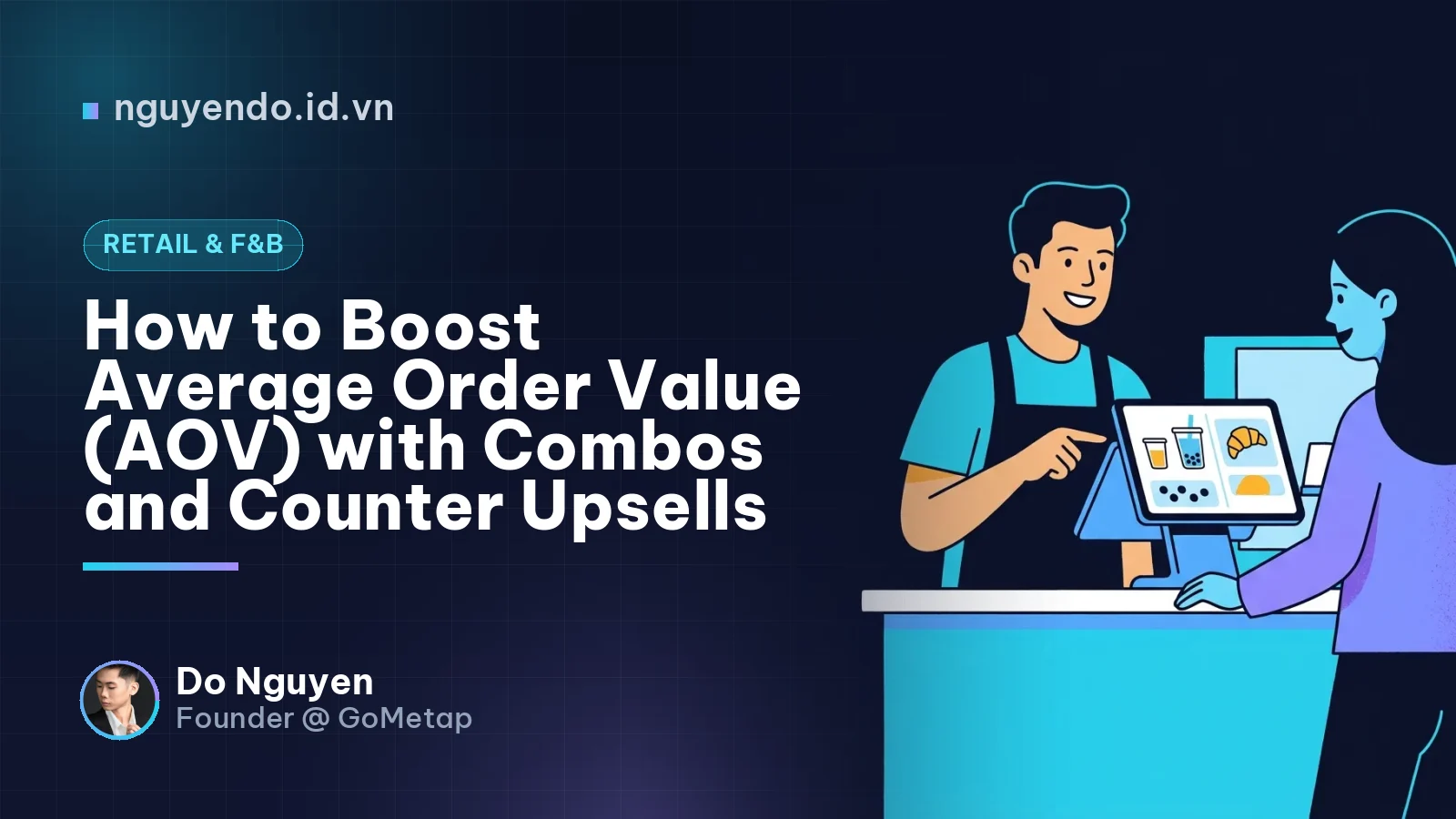
Table of contents
- What Is Average Order Value (AOV) and Why Does It Matter?
- Distinguishing Upselling, Cross-Selling, and Combos in F&B
- Step 1: Design an Intentional Size and Topping Hierarchy
- How to Price Your Size Ladder
- Grouping Toppings by Drink Category
- Step 2: Create Daypart Combos Tailored to Real Customer Needs
- Step 3: Configure Automated Prompts in Your POS Software
- Step 4: Train Cashiers on the 5-Second Counter Script
- Step 5: Measure Performance and Iterate Weekly
- Immediate Weekly Action Checklist for Store Owners
Increasing Average Order Value (AOV) is the fastest way for cafes, boba shops, and small eateries to grow revenue without spending extra marketing budget on customer acquisition. Instead of simply waiting for guests to order a basic item, store owners can proactively increase check sizes by 15% to 30% through strategic menu design, automated POS prompts, and concise counter scripts. This article provides a step-by-step guide to establishing a practical, easy-to-implement upsell and cross-sell system for small food and beverage operations.
What Is Average Order Value (AOV) and Why Does It Matter?
Average Order Value (AOV) is the average amount of money a customer spends during a single transaction at your store, calculated by dividing total revenue by the total number of orders over a specific timeframe.
For example: Suppose a small boba shop generates 5,000,000đ in daily revenue from 100 orders. In this case, the shop's AOV is 50,000đ per order.
When looking to grow revenue, many owners immediately turn to running ads or offering steep discounts to acquire new customers. However, customer acquisition costs continue to climb, not to mention that bar preparation capacity during peak hours is strictly limited. If the shop can simply encourage 40 out of those 100 customers to add a 15,000đ topping or pastry, daily revenue immediately increases by 600,000đ (equivalent to 18,000,000đ/month)—with the exact same foot traffic and fixed rent and labor costs.
Even better, add-ons like boba pearls, cheese foam, jellies, and pastries typically carry lower cost-of-goods-sold (COGS) percentages than primary beverages and require virtually no extra prep time on the spot (since they are batch-prepped in advance). Consequently, incremental revenue driven by higher AOV delivers exceptionally high net profit margins.
Distinguishing Upselling, Cross-Selling, and Combos in F&B
To build an effective menu, owners must understand three fundamental ticket-building techniques:
- Upselling: Encouraging customers to choose a premium version, a larger size, or add-ons for the item they just selected (e.g., upgrading from a size M to size L for only 6,000đ more).
- Cross-selling: Recommending a complementary product from a different category that pairs well with the main item (e.g., suggesting a warm croissant to a customer ordering a sea salt coffee).
- Bundling (Combos): Packaging two or more products together at a slight discount compared to buying them individually, speeding up purchasing decisions while raising the total order value.
| Criteria | Upselling | Cross-selling | Bundling (Combos) |
|---|---|---|---|
| Core Concept | Upgrading the selected item (size, topping) | Adding a complementary item from another category | Pre-packaged pairing of a drink + food item |
| In-Store Example | Add cheese foam (+10,000đ) or size up to L (+7,000đ) | Ordering peach tea, adding a slice of tiramisu | Morning Combo: 1 Iced Milk Coffee + 1 Baguette Stick |
| Operational Impact | Does not slow down drink prep speed | Requires fetching items from pastry case/kitchen | Speeds up customer ordering time |
| Staff Suggestion Difficulty | Very easy; customer decides in 3 seconds | Moderate; depends on appetite for snacks | Easy; usually clearly visible on the menu board |
Step 1: Design an Intentional Size and Topping Hierarchy
Avoid listing dozens of disconnected toppings that overwhelm customers at the counter. The operational rule of thumb is: create intentional Best Pairings for each drink category.
How to Price Your Size Ladder
The price gap between sizes should not be so wide that it creates hesitation, yet it must be high enough to cover incremental ingredient costs. In practice, a price step of 5,000đ to 8,000đ represents the most friction-free psychological threshold for cafes and tea shops.
Example for a small boba shop:
- Classic Milk Tea Size M (500ml): 28,000đ
- Classic Milk Tea Size L (700ml): 34,000đ (Only 6,000đ more for the guest, while additional tea and milk cost the shop only about 2,000đ).
Grouping Toppings by Drink Category
Instead of burying a list of 12 toppings at the bottom corner of your menu, place the top two pairings directly underneath the flagship drink:
- Under Fruit Teas: Explicitly note "Best paired with Water Chestnut Pearls or Aloe Vera (+7,000đ)".
- Under Strong Milk Teas: Note "Pairs best with Egg Pudding or Cream Cheese Foam (+10,000đ)".
Step 2: Create Daypart Combos Tailored to Real Customer Needs
Customers rarely purchase combos if they feel forced to buy something they don't want (such as pairing a slow-moving item with a best-seller). A successful combo must fit into the customer's immediate consumption context.
- Quick Breakfast Combo (6:30 AM - 9:30 AM): Pair 1 coffee (black/condensed milk/white coffee) + 1 pastry or mini baguette. If purchased separately, Milk Coffee (25,000đ) + Croissant (25,000đ) = 50,000đ; set the Morning Combo at 45,000đ. The customer saves 5,000đ, and you capture 45,000đ instead of just a 25,000đ coffee sale.
- Afternoon / Pair Combo (2:00 PM - 5:00 PM): Target office workers or students visiting in groups. For example: "2 Large Fruit Teas + 1 snack portion (sunflower seeds/shredded chicken jerky)" priced at a round, split-friendly number.
- Weekend Family Combo: Include a complimentary kid-sized drink (such as an S-sized brown sugar fresh milk or iced cocoa) when parents order two large specialty beverages.
Step 3: Configure Automated Prompts in Your POS Software
The most common operational mistake is relying entirely on staff memory to recommend combos and toppings. During rush hours or when onboarding new part-time staff, cashiers will instinctively punch in only what the customer says just to clear the queue faster.
To automate this process, configure Modifiers (Add-on Option Groups) directly within your Point of Sale (POS) software.
A POS Modifier is a setting that forces or prompts optional selections (sweetness level, ice level, size, toppings, side items) to automatically pop up on screen the moment a cashier taps a main item.
How to set this up effectively in POS:
- Required Modifiers: Size (M/L), Ice level, Sweetness level. The cashier cannot proceed to checkout without selecting these parameters.
- Optional Upsell Modifiers: Directly beneath the size selection on the same pop-up screen, pre-configure 3 prominent buttons for that drink's top 3 best-selling toppings. When these options appear directly in front of the cashier, verbalizing the prompt becomes second nature.
On modern commerce and operational platforms like GoMetap, setting up menus by modifier groups, time-based combos, and synchronizing them directly with dynamic counter-top QR payment displays allows cashiers to complete orders in just a few taps. Furthermore, when integrated with digital membership passes on Apple Wallet or Google Wallet, store owners can introduce automated loyalty tiers such as: "Earn bonus points or receive a free topping on orders over 60,000đ", providing organic incentive for guests to exceed the shop's baseline AOV.
Step 4: Train Cashiers on the 5-Second Counter Script
Technology handles the on-screen prompting, but the cashier's phrasing seals the sale. The golden rule when training staff to upsell is: Avoid yes/no questions; offer specific, benefit-driven choices instead.
Consider the difference between two approaches at a counter:
- Ineffective (high rejection rate): "Would you like any pastries or toppings today?" -> The instinctive reflex for 90% of customers is a flat: "No, thanks."
- Guided approach (high conversion rate):
- When a customer orders Peach Orange Lemongrass Tea: "Would you like the size M, or add 6,000đ to upgrade to a large for extra refreshment?"
- After the size is selected: "Customers love pairing this with our crunchy water chestnut pearls—shall I add a scoop for you?"
- When a customer orders morning coffee: "We just pulled freshly baked croissants from the oven. If you grab one with your coffee, you save 5,000đ—can I add one to your tray?"
Each prompt takes only 3 to 5 seconds. It never feels pushy as long as staff maintain a friendly tone and limit themselves to a single prompt per transaction.
Step 5: Measure Performance and Iterate Weekly
Once implemented, avoid relying on guesswork. Review your POS reporting data at the end of each week:
- Track Shift-Level AOV: Compare AOV figures before and after deploying the scripts. If the morning shift maintains a significantly higher AOV than the evening shift with similar volume, inspect what the morning team is doing right and replicate it.
- Pastry and Topping Attach Rate: Out of 100 orders, how many include at least one add-on? A realistic target for an independent shop is raising this attach rate from a passive 10–15% baseline up to 30–35%.
- Micro-Incentives for Staff: Allocate a small portion of the margin generated from exceeding weekly topping and pastry targets directly to the working shift (e.g., a 1,000đ bonus for every successfully upsold pastry). When staff see a clear financial incentive tied to making recommendations, the process sustains itself without constant owner supervision.
Immediate Weekly Action Checklist for Store Owners
You do not need to overhaul your entire menu at once. Start taking action using the checklist below:
- Audit Current AOV: Open your POS report for the last 30 days, divide total gross revenue by total invoice count, and establish your true baseline.
- Identify 3 Flagship Items: Find your top 3 best-selling drinks and assign 1–2 high-margin, complementary toppings to each.
- Design 1 Daypart Combo: Launch a morning breakfast deal (Coffee + Pastry) or afternoon pair combo highlighted via a counter tent card placed right beside the POS screen.
- Reconfigure POS Modifiers: Set up auto pop-up prompts for size upgrades and top-selling toppings whenever a flagship drink is selected.
- Post a Counter Cheat-Sheet: Write down 2 concise upsell lines and tape them to the corner of the POS monitor to guide staff through the first 3 days until it becomes second nature.
- Review After 7 Days: Inspect AOV shifts and topping/side category revenue at week's end to fine-tune pricing or cashier phrasing.
Comments
No comments yet. Be the first to share your thoughts!