
How to Boost Customer Retention for Cafes and Milk Tea Shops in 30 Days
A step-by-step guide to capturing customer info at checkout, launching digital membership cards, and scripting second-visit hooks for small cafes and milk tea shops.
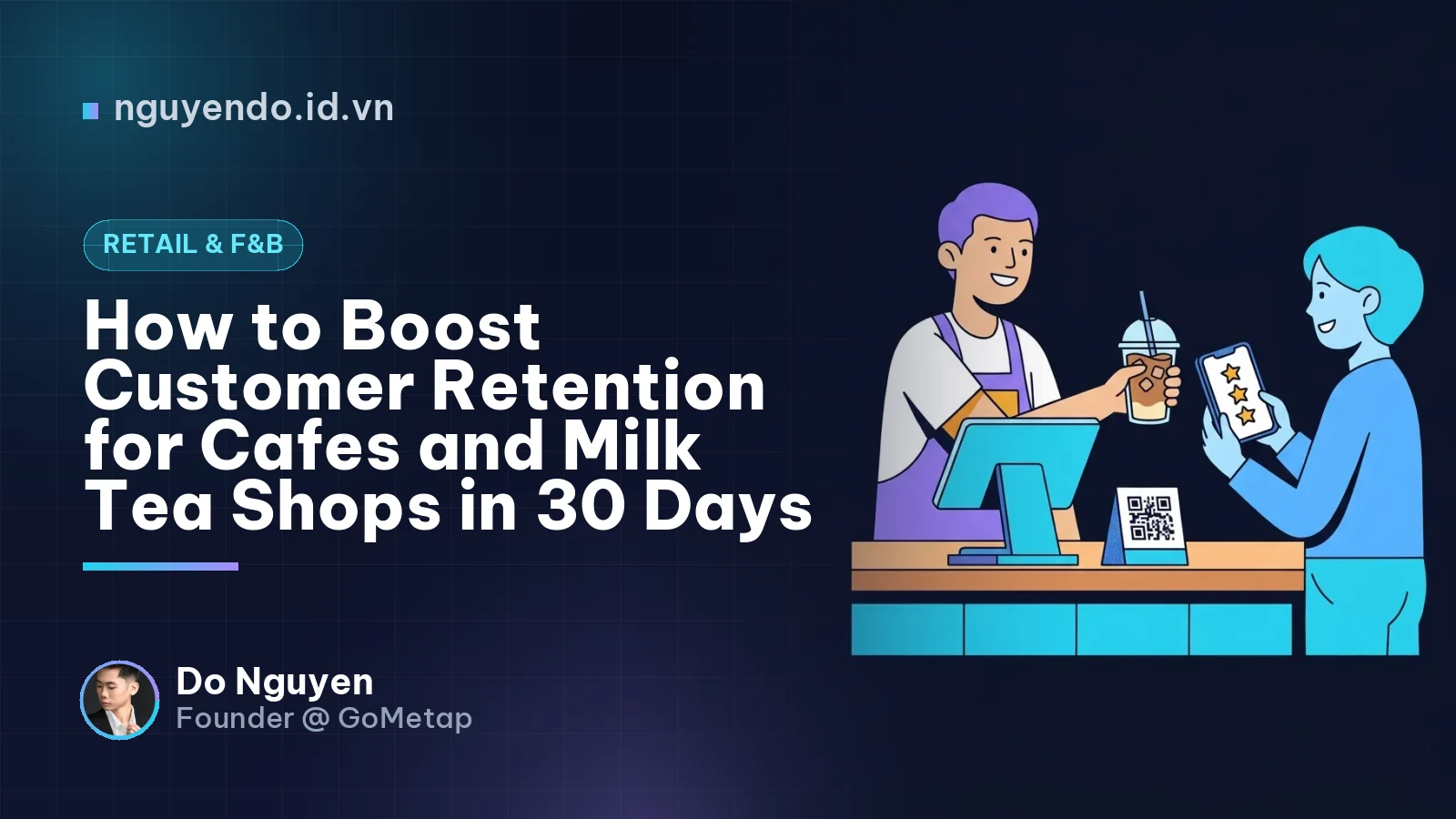
Table of contents
- What Is Customer Retention Rate in F&B, and Why Is It Vital for Small Shops?
- Why Do Customers Praise the Drinks Yet Never Return?
- A 5-Step Process to Boost Customer Retention for Small Shops
- Step 1: Design a "Second-Visit Hook" Instead of Waiting for the 10th Cup
- Step 2: Choose a Frictionless Counter Tool to Capture Customer Data
- Step 3: Standardize a 10-Second Script for Cashiers
- Step 4: Automate Segmentation and Win-Back Reminders
- Step 5: Give Customers a Reason to Return Through Consistency and Habit
- Practical Case: Customer Retention for a 30m² Cafe
- Action Checklist for Shop Owners This Week
To increase customer retention for a cafe or milk tea shop, owners must solve a core problem: turning an anonymous walk-in guest into an identified customer in the system right at checkout, then using a short-expiry offer to draw them back for a second visit within 7 to 14 days. Instead of handing out paper stamp cards that get lost or forcing people to download complex apps, combining a 10-second checkout flow with digital membership cards is the most practical and cost-effective approach for small businesses.
What Is Customer Retention Rate in F&B, and Why Is It Vital for Small Shops?
Customer Retention Rate is the percentage of customers who continue purchasing from your store over a specific timeframe compared to the total customer count from the preceding period.
Many store owners pour their entire marketing budget into opening day: running local ads, hiring KOL reviewers, offering 50% discounts, or running buy-1-get-1 promos. The result is a packed first week, but by month two, revenue falls off a cliff. The issue isn't necessarily poor drinks, but rather that the shop lacks any mechanism to stay in touch with the crowd that stopped by.
For a small cafe or milk tea shop, the service radius is typically confined to 1–3 km around residential areas, office buildings, or schools. The pool of new potential customers in this zone is finite. If you rely solely on one-and-done walk-ins, rent and payroll costs will quickly erode your margins.
Why Do Customers Praise the Drinks Yet Never Return?
Before designing a customer retention program, we must confront operational realities at the counter. Most customers do not return due to 4 very common barriers:
- Forgetting the shop exists: Around any office building in Vietnam, there can be dozens of beverage shops and drink carts. Even if your milk tea is delicious, customers are easily distracted by another newly opened spot next week.
- Friction with loyalty programs: Physical stamp cards are left at home or ruined in the wash. Asking customers to download a standalone brand app at the register just to earn a tiny reward is virtually impossible during peak hours.
- Cashier hesitation: When a long line forms, cashiers often skip asking for customer details to speed up checkout.
- Rewards are too far off: A "Buy 10, get 1 free" scheme sounds reasonable to the owner, but to a first-time customer, 10 drinks is too distant an objective to motivate action.
A 5-Step Process to Boost Customer Retention for Small Shops
Here is a step-by-step roadmap that any small cafe, milk tea shop, or bakery can implement within a week without needing a dedicated marketing team.
Step 1: Design a "Second-Visit Hook" Instead of Waiting for the 10th Cup
A Second-Visit Hook is an incentive designed specifically to shorten the window between a new customer's first and second purchase.
In F&B, the gap between visit 1 and visit 2 is the widest chasm. If a customer returns for visits 2 and 3, your shop has likely entered their regular rotation.
- The old approach: Collect 10 stamps to get 1 free drink.
- The new approach: On the first purchase, when a customer signs up as a member, immediately grant a specific perk for their next visit within 7 days (e.g., a free topping, a free upsize, or a 10,000 VND discount on their next order).
Hypothetical example: A small milk tea shop has an average order value of 35,000 VND/cup, while the cost of goods sold (COGS) for a portion of white boba is around 2,500 VND. Offering a "Free topping on your next purchase (valid for 7 days)" voucher costs the shop only 2,500 VND in ingredient costs when the customer actually returns for cup number two, bringing in another 35,000 VND order and cultivating a store habit.
Step 2: Choose a Frictionless Counter Tool to Capture Customer Data
To get customers to join willingly, the checkout interaction must take under 10 seconds. Let's compare 3 popular approaches:
| Criteria | Paper Stamp Cards | Dedicated Brand App | Phone Number on POS + Digital Wallet Card (Apple/Google) |
|---|---|---|---|
| Customer experience | Easy to lose or damage; must carry a wallet | Consumes storage, tedious download, forgotten passwords | 5-second QR scan, saved directly to native mobile wallet |
| Data captured by owner | None (lose the card, lose the customer) | Complete, but app install rate is extremely low | Name, phone number, and purchase history linked to POS |
| Remarketing capability | Cannot proactively message | Push notifications supported, but often disabled | Lock-screen notifications via digital Wallet pass or Zalo |
| Fraud risk | Cashiers can easily stamp cards illicitly | Low | Low (synced directly with checkout receipts) |
The most practical solution today for SMEs is combining phone number entry at the POS terminal or letting customers scan a QR code to add a digital membership card directly into Apple Wallet (on iPhone) and Google Wallet (on Android). This is the approach supported by the GoMetap O2O ecosystem for small shops: customers pay, scan a QR code to save a digital membership pass to their smartphone without installing third-party apps, automatically earn loyalty points, and allow the owner to manage customer segments centrally.
Step 3: Standardize a 10-Second Script for Cashiers
Even the best technology will fall flat if counter staff ask customers an uninspiring question like: "Would you like to collect points?" The default reflex for most busy customers is: "No thanks."
Switch from closed questions to ones tied directly to an immediate benefit:
- Standard checkout script: "Your total is 45,000 VND. Could you share your phone number (or scan this QR code for 3 seconds) to get your digital membership card? On your next visit, you'll receive a free topping!"
- Operational tip: Place a small tent card right next to the payment QR code with concise copy: "Scan for Digital Membership – Get a Free Topping on Your Next Visit." While waiting for drinks to be prepared or receipts to print, customers naturally glance around the counter and scan on their own.
Step 4: Automate Segmentation and Win-Back Reminders
Once transaction data is stored in the POS and membership system, you don't need to manually filter through each customer. Segment customers into 3 foundational groups for tailored engagement:
- New customers (1 purchase): If they haven't returned to redeem their welcome perk after 5 days, send an automated nudge (via mobile Wallet pass notifications or Zalo ZNS): "Hey there! Your free upsize gift for visit #2 expires this Sunday!"
- Regulars (2–3 visits/month): This group already likes your drinks. Retain them through point-based rewards or tier upgrades (e.g., Silver Tier gets 5% off all orders).
- At-risk customers (No visit in 21–30 days): Send a slightly more generous "We miss you" offer (e.g., 15,000 VND off orders over 45,000 VND) to win them back before they forget your brand entirely.
Step 5: Give Customers a Reason to Return Through Consistency and Habit
No loyalty program can rescue a business whose drinks are inconsistent. Alongside digital tools, owners must lock down 2 operational pillars:
- Consistency across shifts: Ensure beverage recipes (exact measurements of syrup, tea, milk) are standardized so customers get the exact same flavor profile whether visiting in the morning or evening.
- Time- or day-specific specials: For instance, an office-area cafe might launch "Happy Wednesday – Double Loyalty Points from 1:00 PM to 3:00 PM" (a typically slow post-lunch window). Over time, customers develop a reflex to invite colleagues over every Wednesday afternoon.
Practical Case: Customer Retention for a 30m² Cafe
Consider a hypothetical scenario for a compact take-away and dine-in cafe catering to office workers:
- Average Order Value (AOV): 40,000 VND/order.
- Objective: Guide a first-time walk-in customer to make 3 visits within their first 30 days.
Designing the 30-Day Journey:
- Visit 1 (Day 1): Customer purchases a Bac Xiu for 35,000 VND. At checkout via dynamic QR, they scan to save a membership card to Apple Wallet. They instantly receive a voucher for "10,000 VND off your next order of 35,000 VND or more (valid 10 days)" displayed on their pass.
- Visit 2 (Day 6): A lock-screen notification alerts them that the voucher is expiring soon. The customer visits and buys a Peach Orange Lemongrass Tea (40,000 VND), discounted by 10,000 VND to 30,000 VND. Upon payment, the system awards loyalty points and unlocks a challenge: "Make 1 more purchase this month to unlock a free Garlic Butter Croissant."
- Visit 3 (Day 15): The customer returns for coffee and redeems their free pastry. By now, they have visited 3 times in two weeks, know the shop's location, are familiar with the staff, and hold a digital card on their phone. From visit 4 onwards, they are an established regular without requiring deep discount incentives.
Action Checklist for Shop Owners This Week
You don't have to tackle everything at once. Print or save this 7-item checklist to audit your store operations step by step:
- Audit your current POS: Does your point-of-sale software track purchase history by phone number or digital membership card?
- Remove counter friction: Stop issuing physical paper cards; transition to phone-number-based tracking or digital wallet passes (Apple Wallet / Google Wallet) so customers never leave their cards behind.
- Finalize a 2nd-visit perk: Select a low-COGS, high-perceived-value perk (toppings, upsizes, small pastries) with a 7–14 day expiration window.
- Print a small QR tent card for the register: State the member perk clearly in a single sentence under 12 words.
- Rehearse the 10-second script with your team: Have morning and evening shift staff practice introducing the loyalty perk with clear value upfront.
- Assign modest shift KPIs: For example, target each shift to enroll at least 15–20 new member registrations (reconciled against POS order counts to prevent spoofing).
- Review weekly reports: Check the percentage of identified customer orders out of total transactions to refine your team's checkout prompts.

Comments
No comments yet. Be the first to share your thoughts!