
Points, Stamps, or Cashback: Which Loyalty Model Fits Your SME?
An analysis of the pros and cons of the three most popular loyalty models: points, stamps, and cashback. A guide to choosing the right customer retention strategy for F&B and retail businesses.
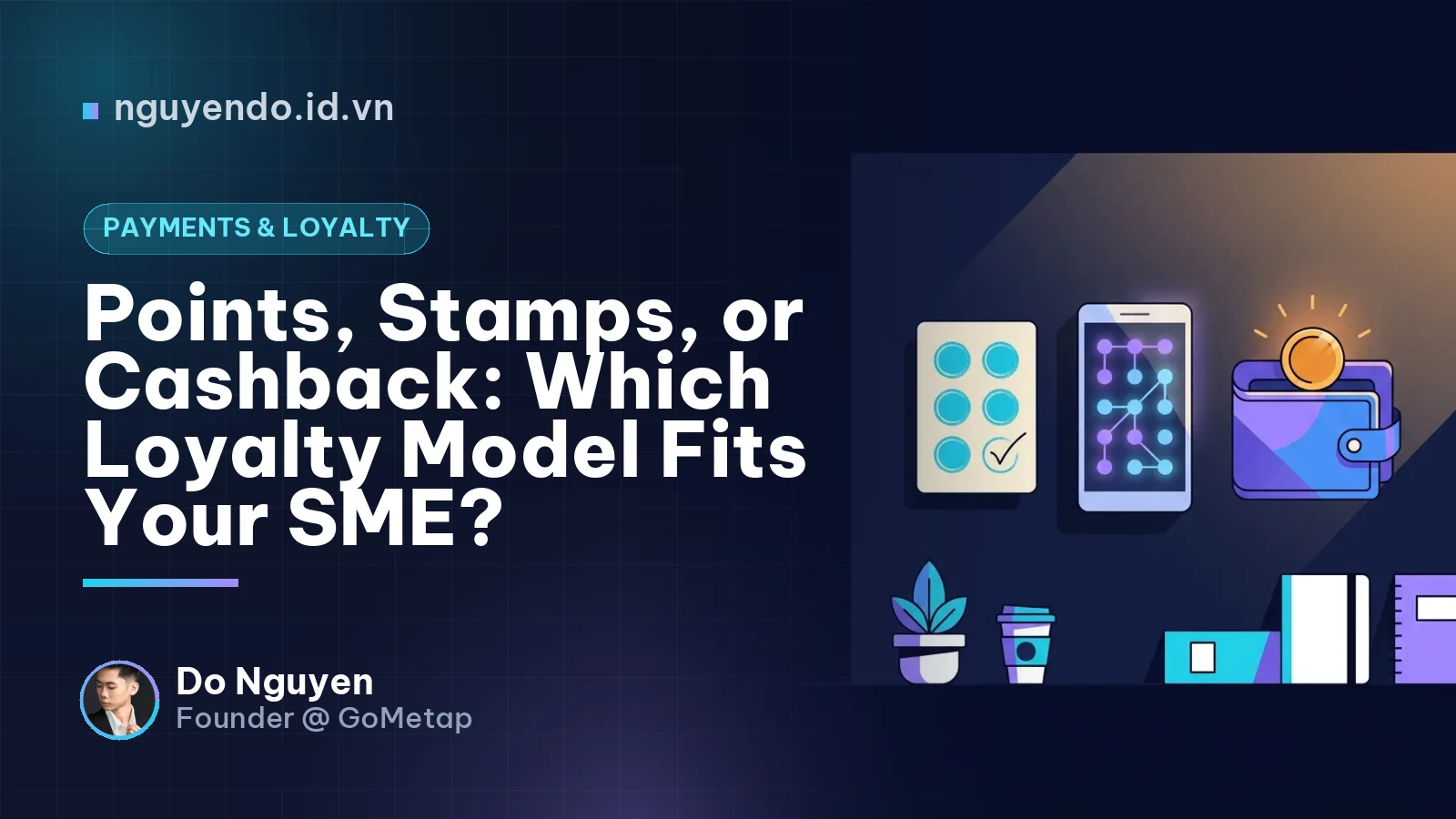
Table of contents
- 1. Defining Fundamental Loyalty Models
- 2. Comparison Table: 3 Customer Retention Models
- 3. In-Depth Analysis and Practical Applications
- 3.1. Stamps - The Power of Simplicity
- 3.2. Points for Rewards
- 3.3. Store Cashback
- 4. The Financial Equation: How to Calculate Rewards Without Losing Money
- 5. Digitizing Your Loyalty Program for Operational Efficiency
- 6. Conclusion
Points, stamps, and store cashback are the three most popular loyalty models helping small businesses retain customers effectively. Choosing the right model depends not only on the spending habits of your target audience, but also on your profit margins, average order value, and operational capabilities. A properly designed loyalty program, paired with digital wallet technology, will increase customer visit frequency without eroding your gross profit.
1. Defining Fundamental Loyalty Models
To choose the right strategy, we first need to clarify the mechanics of each model through the following definitions:
- Points-based Program: A loyalty model where buyers earn points proportional to their order value, which can later be redeemed for rewards or discounts on future purchases.
- Stamp/Punch Card Program: A promotion format based on unit volume or visit frequency; customers collect a predetermined number of stamps to earn a fixed reward (typically a free item).
- Store Cashback: A mechanism that credits a percentage of the customer's total bill back as "store credit" stored in their member account, which can only be applied toward future purchases at that specific business.
2. Comparison Table: 3 Customer Retention Models
Here is a quick comparison table to give you an overview before diving into the detailed analysis:
| Criteria | Stamps | Points | Cashback |
|---|---|---|---|
| Simplicity | Very High (Easiest to understand) | Moderate (Requires conversion rules) | Very High (1 dollar = 1 dollar) |
| Reward Flexibility | Low (Only redeems a fixed item) | High (Redeemable for multiple items) | High (Direct bill reduction) |
| Psychological Driver | Goal completion (Gamification) | Long-term asset accumulation | Instant financial savings |
| Suitable Verticals | Coffee, bubble tea, car wash, barbershop | Casual dining, cosmetics, supermarkets | Fashion, spa, maternal & baby |
3. In-Depth Analysis and Practical Applications
Choosing the right model depends heavily on your specific business context. Let's explore the pros, cons, and ideal use cases for each.
3.1. Stamps - The Power of Simplicity
Stamp cards are an old-school format that remains remarkably effective because they tap into the Endowed Progress Effect. The classic example: "Buy 10 drinks, get 1 free."
- Pros: Instant comprehension. Zero complex math. A tangible sense of progression toward a reward with every purchase.
- Cons: Lack of flexibility. A customer spending $25 earns the same single stamp as one spending $3 (if stamps are issued per visit), creating perceived unfairness and failing to incentivize larger basket sizes.
- When to use: Ideal for high-turnover businesses with standardized offerings, low ticket sizes, and high visit frequency—such as morning grab-and-go coffee shops or barbershops.
3.2. Points for Rewards
This is the most common model found in modern CRM and POS systems. A standard mechanic looks like: "Spend $1 = Earn 1 point. Redeem 100 points for a free appetizer or a $5 voucher."
- Pros: Highly equitable. The more a customer spends in a single order, the more points they accumulate, which naturally drives up average basket size. Customers also enjoy the autonomy of choosing their reward.
- Cons: Can easily feel uninspiring if point accumulation feels negligible or rewards are set too far out of reach. The feeling of "I'll never reach enough points" causes customers to disengage early.
- When to use: Well-suited for full-service restaurants, bistros, and beauty retailers—environments with diverse product catalogs and wide variations in customer basket values.
3.3. Store Cashback
Instead of offering virtual reward points, you award customers actual monetary balances locked within your ecosystem. Example: "Get 5% cashback on orders over $50, redeemable directly on your next purchase."
- Pros: Exceptionally high perceived value. Customers easily grasp the real-world value and feel they are genuinely saving money. It creates a compelling incentive to return soon before the balance expires.
- Cons: Can directly compress profit margins if the cashback percentage is not calculated carefully. Customers may view it purely as a delayed price cut rather than developing an emotional connection with your brand.
- When to use: Particularly effective for higher-ticket service and retail businesses with moderate purchase frequencies (once every 1–3 months), such as boutique fashion, day spas, wellness clinics, or specialty baby stores.
4. The Financial Equation: How to Calculate Rewards Without Losing Money
One of the biggest mistakes SME founders make is confusing the Nominal Discount with the Actual Cost.
For example: You run a stamp promotion: "Buy 10 drinks, get 1 free." Each drink retails for $5.
- The customer buys 10 drinks, spending $50.
- You give away 1 drink with a menu price of $5.
- On the surface, the discount rate appears to be $5 / $50 = 10%.
However, your actual cost is far lower than 10%. The Cost of Goods Sold (COGS) in the F&B industry typically hovers around 30%. That means a $5 beverage only costs you $1.50 in raw ingredients. Therefore, the actual cost of this loyalty promotion is: $1.50 / $50 = 3%.
Takeaway: Always design your loyalty economics around your COGS. You can afford to be generous with complimentary product rewards (because your real cost is low) rather than handing out cash-equivalent discounts on total checks (since discounting 10% off gross sales cuts cash revenue by a full 10%).
5. Digitizing Your Loyalty Program for Operational Efficiency
Regardless of whether you choose points, stamps, or cashback, the greatest enemy of customer loyalty is friction. Customers lose paper cards, leave them at home, or get annoyed when cashiers take too long asking for phone numbers at checkout.
Having worked directly with thousands of SMEs through their digital transformation journeys, I have seen a massive improvement when shifting from physical paper or plastic cards to mobile passes on Apple Wallet and Google Wallet.
- Customer Experience: Zero app downloads required. Membership passes live directly inside the smartphone's native wallet and can automatically deliver Push Notifications when customers walk past your shop or when points are about to expire.
- Frictionless Payment Integration: The most seamless implementation integrates loyalty directly into the payment flow. For instance, when using an O2O ecosystem like GoMetap, customers simply scan a dynamic VietQR code to pay. As soon as automated payment reconciliation confirms the funds, points or stamps are instantly credited to the customer's Apple Wallet pass without the cashier lifting a finger.
This approach eliminates fraudulent receipt claims while removing transaction friction entirely, often boosting loyalty enrollment rates by more than 50%.
6. Conclusion
There is no one-size-fits-all model. If you run a quick-serve coffee shop, choose Stamps so customers experience quick wins. If you operate a multi-item restaurant, opt for Points to provide greater flexibility. And if you manage a fashion boutique or salon, Store Cashback acts as the perfect hook to bring customers back to spend their accrued balance.
Above all, remember that loyalty programs are not free handouts—they are a targeted marketing investment (typically costing 3–5%) to reacquire your existing customers. Keep the rules intuitive, and bring that experience directly onto your customers' smartphones as early as possible.
Comments
No comments yet. Be the first to share your thoughts!