
The Pay & Earn Model: Integrating VietQR Payments and Automated Loyalty Points
Combining VietQR payments and automated loyalty points (Pay & Earn) helps SMEs cut checkout times and boost loyalty enrollment without the friction.
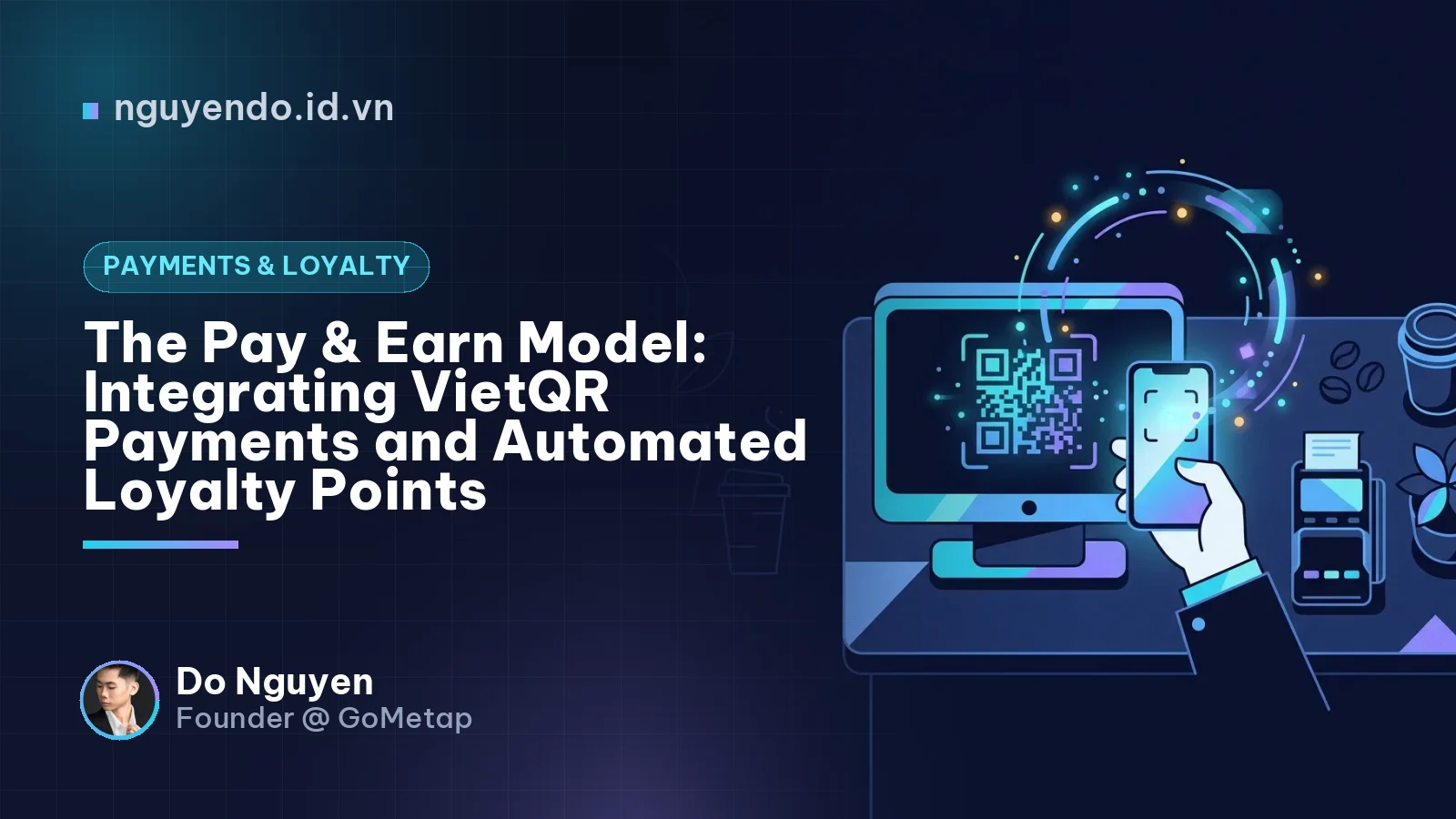
Table of contents
- Checkout Bottlenecks During Peak Hours
- What Is Pay & Earn?
- How Does a Pay & Earn System Work in Practice?
- Traditional Experience (Takes 45–60 Seconds)
- The Pay & Earn Experience (Takes 10–15 Seconds)
- Why Small Businesses Should Invest in This Model
- 1. Optimize Processing Speed and Operating Expenses (Speed & Opex)
- 2. Frictionless, Natural Data Collection
- 3. Prevent Fraud
- Steps to Implement Pay & Earn for SMEs
- Checkout Process Comparison
- Conclusion
Integrated payment and loyalty rewards (Pay & Earn) is a model that unifies scanning to pay and earning reward points into a single checkout step. This approach allows retailers and coffee shops to minimize wait times, eliminate the awkwardness of reciting phone numbers in public, and significantly boost customer loyalty enrollment.
As business leaders, we often focus on product quality and high-profile marketing campaigns. Yet the decisive touchpoint for customer experience frequently boils down to 30 seconds at the cash register. Forcing customers through multiple hurdles just to pay and earn a few points introduces unnecessary friction.
Checkout Bottlenecks During Peak Hours
Picture a coffee shop at 8:00 AM. Customers are in a rush to get to work. When their turn comes, the cashier asks: "Do you have a membership card?" The customer hesitates, struggles to recall their phone number, or tries to launch an app on weak mobile data. The queue behind them quickly grows impatient.
Even worse, customers who feel uncomfortable reciting their personal phone numbers in front of strangers simply decline: "Never mind, let's just complete the payment." As a result, the business misses a valuable data collection opportunity, while the customer walks away without their rewards.
This is a classic pitfall of traditional loyalty programs. Unless this bottleneck is resolved, every tier design or birthday promotion falls flat because customers simply refuse to engage from step one.
What Is Pay & Earn?
Pay & Earn: An automated process that identifies a member and accrues loyalty points the instant a payment transaction completes, without requiring the customer to recite a phone number or present a standalone loyalty card.
Dynamic VietQR: A payment QR code generated specifically for an individual order directly from the point of sale (POS) software, pre-filled with the exact payment amount and a unique transaction reference code.
How Does a Pay & Earn System Work in Practice?
To understand the contrast, let's compare two counter checkout scenarios:
Traditional Experience (Takes 45–60 Seconds)
- The cashier totals the order and asks for the customer's phone number.
- The customer recites the number. The cashier keys it into the POS to look up the profile.
- The cashier announces the total. The customer opens their banking app and manually enters the transfer amount by scanning a static QR code placed on the counter.
- The customer shows their phone screen to prove the transfer succeeded.
- The cashier taps confirm on the POS, prints the receipt, and the system credits the points.
The Pay & Earn Experience (Takes 10–15 Seconds)
- The customer taps their phone holding an Apple/Google Wallet pass against the reader, or the cashier scans the barcode on the customer's Wallet pass.
- The customer-facing POS display instantly reflects the customer's name, current point balance, and a dynamic VietQR code with the payable amount (after deducting member discounts).
- The customer scans the dynamic VietQR to pay.
- The moment the bank notification arrives, the POS automatically reconciles the payment, closes the order, prints the receipt, and credits points. The customer receives an immediate balance update notification right on their Apple/Google Wallet pass.
Why Small Businesses Should Invest in This Model
As the founder of GoMetap, working alongside thousands of SME owners has taught me a fundamental lesson: digital transformation isn't about shoehorning complex technologies into your business. It is about making everyday interactions so seamless that neither your staff nor your customers notice the underlying tech.
Unifying payments and loyalty yields three critical advantages for an O2O (Online-to-Offline) business model:
1. Optimize Processing Speed and Operating Expenses (Speed & Opex)
Time is money, especially in F&B and retail. Slashing checkout transaction time from 60 seconds down to 15 seconds means your staff can serve 3 to 4 times more customers during peak hours without adding extra cashier headcount.
2. Frictionless, Natural Data Collection
When customers realize their Apple/Google Wallet pass is not just a loyalty card but also the key to unlocking instant discounts and rapid checkout via dynamic QR, they proactively present it. Cashiers no longer have to push: "Are you a member?" Customer profile data (CRM) stays clean, accurate, and up to date.
3. Prevent Fraud
Fragmented workflows create vulnerabilities. When payments and loyalty tracking are decoupled, cashiers might enter their own or their family's phone numbers into the POS for walk-in shoppers who don't care about points. With Pay & Earn powered by dynamic VietQR, the loop is closed: points are credited transparently and mapped directly to the paying bank account and authenticated Wallet pass.
Steps to Implement Pay & Earn for SMEs
Many business owners assume this architecture is reserved for enterprise chains like Starbucks. In reality, modern API technology enables independent coffee shops to launch this workflow within days.
- Step 1: Upgrade to a POS with open API support: Your POS software must be able to communicate with third-party systems (banking providers and loyalty platforms).
- Step 2: Deploy dynamic VietQR solutions: Subscribe to an automated reconciliation service using dynamic QR codes. These codes must be rendered per transaction directly on the POS screen or customer-facing display.
- Step 3: Roll out Apple/Google Wallet passes: Instead of forcing customers to download an app (App-less Loyalty), issue digital membership passes directly into their phone's native digital wallet.
- Step 4: Synchronize data flows: Ensure the end-to-end logic runs smoothly: Customer Identification -> Apply Member Discounts -> Generate Payment QR -> Receive Payment Webhook -> Settle Order & Credit Points -> Push Notification to Wallet pass.
At GoMetap, we designed our ecosystem around this unified philosophy. Bundling the POS, VietQR payment solutions, and Wallet pass issuance into a single platform shields SMEs from fragmented data silos and shortens implementation timelines.
Checkout Process Comparison
| Metric / Step | Traditional Experience | Pay & Earn Model |
|---|---|---|
| Customer identification | Reciting phone number (Slow, error-prone, privacy risk) | Scanning Apple/Google Wallet pass (Fast, secure) |
| Payment method | Cash / Scanning static QR and manually typing amount | Scanning dynamic VietQR with exact amount |
| Payment confirmation | Cashier visually checks customer's phone screen | POS automatically receives payment webhook and prints receipt |
| Point accrual | Manual entry after payment completion | Automatic point accrual as soon as the order closes |
| Average transaction time | 45–60 seconds | 10–15 seconds |
Conclusion
Customer loyalty does not start with extravagant rewards; it starts with respecting their time. Adopting the Pay & Earn model—pairing VietQR payments with automated loyalty accrual—is more than a routine tech upgrade. It is a strategic operational move that makes your brand faster, more professional, and more trustworthy in the eyes of everyday consumers.
Audit your checkout counter workflow today. If your customers are still hesitating when asked for their phone numbers, it is time to upgrade.
Comments
No comments yet. Be the first to share your thoughts!