
Dynamic VietQR & Auto-Reconciliation: Stop Fake Receipts
Discover how dynamic VietQR and automated reconciliation eliminate fake transfer receipts, speed up checkout, and elevate customer experience for retail and F&B.
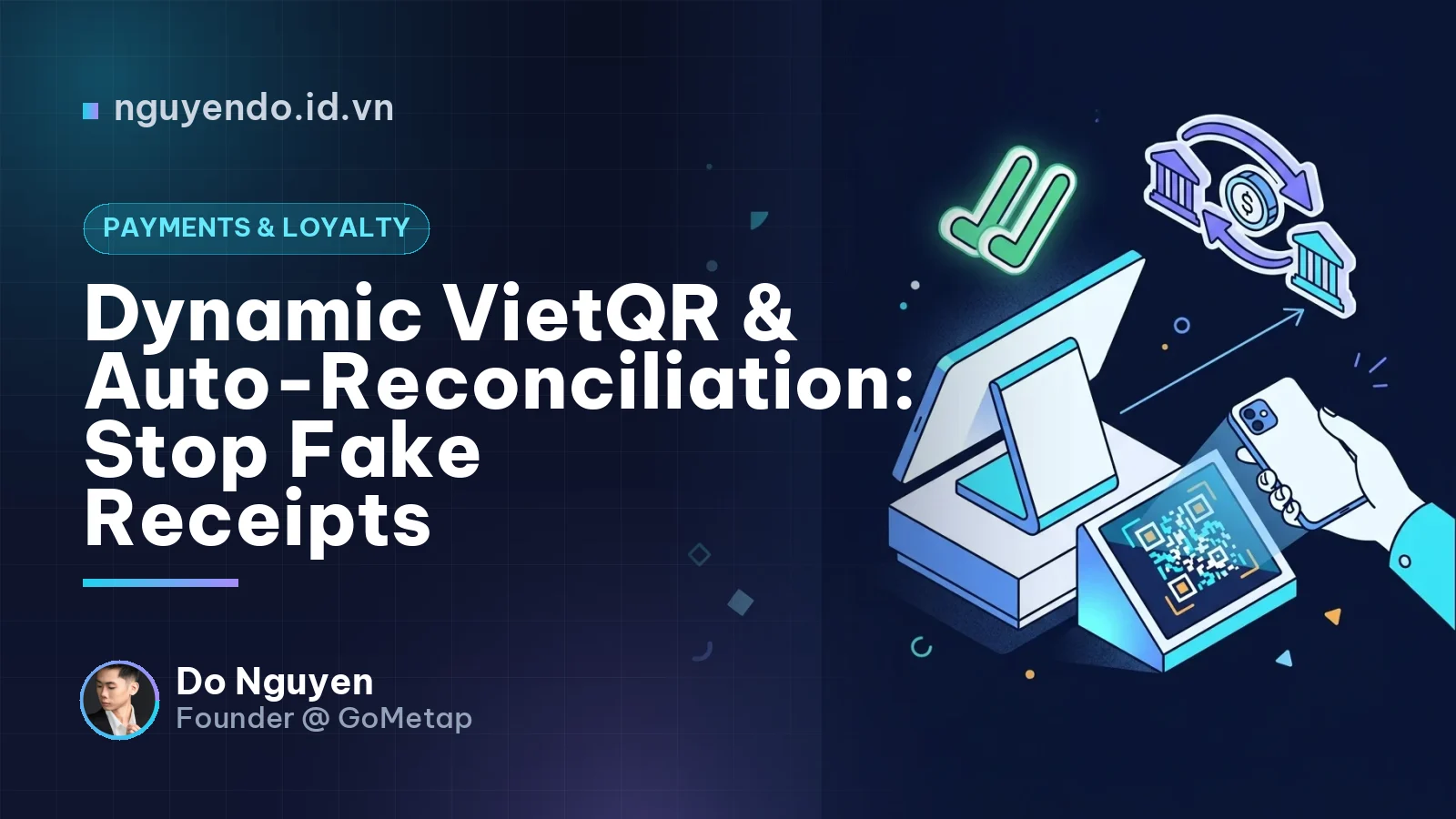
Table of contents
- What are dynamic VietQR and automated reconciliation?
- Comparison: Static VietQR vs. Dynamic VietQR
- Why small stores need automated transfer reconciliation
- 1. Completely eliminate fake transfer receipts
- 2. Free store owners from the "OTP call"
- 3. Eliminate human errors
- How dynamic VietQR payment workflows operate
- Evaluation checklist for SME reconciliation solutions
- The future of payments: Driving customer retention
Dynamic VietQR is a payment QR code generated automatically by software for each specific order with the exact amount and transfer description. Paired with an automated bank transfer reconciliation system, it allows POS terminals to receive transaction results instantly. This solution enables retail and F&B stores to completely eliminate the risks of incorrect transfer amounts and fake payment receipts, while freeing store owners from constantly monitoring balance change notifications. By automating checkout, SMEs can serve customers faster and build a strong foundation for automated customer retention programs.
What are dynamic VietQR and automated reconciliation?
In modern retail, checkout speed and accuracy play a critical role in shaping customer experience. To optimize this touchpoint, two technologies are being widely adopted: dynamic VietQR and automated reconciliation.
Dynamic VietQR is a QR payment code that pre-fills the recipient account details, exact payment amount, and specific order ID. It is generated dynamically and refreshed by the system for each transaction.
Automated reconciliation (auto-clearing) is the process where POS software integrates with banks via API to instantly record incoming cash flow and update order statuses to "Paid" without any manual intervention.
Comparison: Static VietQR vs. Dynamic VietQR
| Criteria | Static VietQR (Printed on paper/acrylic) | Dynamic VietQR (On POS customer display) |
|---|---|---|
| Payment amount | Customers must enter the amount manually | Pre-filled, 100% accurate |
| Transfer description | Customers type manually (often missing or incorrect) | Generated automatically based on the invoice ID |
| Transaction verification | Owner/cashier checks banking alerts (SMS/App) | POS software automatically confirms receipt |
| Processing speed | Slow (takes 1-3 minutes/order) | Fast (only 5-10 seconds/order) |
| CRM integration | Impossible or very difficult to sync | Easily syncs purchase history and reward points |
Why small stores need automated transfer reconciliation
Running a retail store reveals that payment is not just about "receiving money"—it involves significant hidden costs and operational risks. Here are the practical reasons why adopting dynamic VietQR has become essential.
1. Completely eliminate fake transfer receipts
Fake receipt generator apps are becoming increasingly sophisticated, cloning the exact UI of major banking apps. Cashiers, especially during peak hours, can easily be deceived by a quick glance at a customer's phone showing "Transfer Successful." With automated reconciliation, staff release items only when the POS confirms payment receipt with a sound alert. The customer's phone screen is no longer the source of truth.
2. Free store owners from the "OTP call"
Consider a small coffee shop where the owner is away or running errands. When a customer scans a static QR linked to the owner's personal account, the cashier must call or message: "Did you receive the 55,000 VND order?" This frustrates the waiting customer and interrupts the owner's workflow.
3. Eliminate human errors
Missing a trailing zero (e.g., paying 10,000 VND instead of 100,000 VND) is a classic mistake when customers enter amounts manually. In addition, missing transfer descriptions force accountants or owners to spend hours at the end of each day cross-referencing bank statements against individual POS orders.
How dynamic VietQR payment workflows operate
To better understand the process, here is the real-world operational flow in a store running synchronized POS and automated reconciliation systems:
- Finalize the order: The cashier selects items on the POS software. The total bill displays 125,000 VND.
- Generate QR code: The cashier selects "Bank Transfer." The customer display instantly shows a unique VietQR code for that order.
- Customer scans the code: The customer opens their mobile banking app and scans the code. The app automatically populates the recipient details, 125,000 VND amount, and order description (e.g., DH1052).
- Automated verification: As soon as the customer confirms the transfer, the bank's Open Banking infrastructure dispatches a webhook to the POS server within 1-3 seconds.
- Complete the transaction: The POS screen turns green with a "Payment Successful" alert, automatically prints the invoice, and opens the cash drawer. It is a completely frictionless process requiring zero verbal confirmations.
Evaluation checklist for SME reconciliation solutions
Not every system delivers enterprise-grade stability. Drawing from our experience building retail ecosystems at GoMetap, we recommend evaluating solutions against this checklist before signing a vendor contract:
- Processing latency: The time between customer transfer confirmation and POS notification must be under 5 seconds. A 10-15 second delay causes customer impatience and staff confusion.
- Partner bank stability: Opt for solutions that use direct API integrations with tier-1 banks that have robust infrastructure, rather than daisy-chaining through multiple intermediaries that increase failure rates.
- Account ownership: Ensure funds flow directly into your own bank account (or your business account) rather than being held overnight (T+1) by a third party, safeguarding your working cash flow.
- Offline and degraded network handling: Does the software allow cashiers to verify transactions manually if the in-store network drops right after a customer completes a transfer?
The future of payments: Driving customer retention
Checkout is not the end of the customer journey; it is the launchpad for repeat purchases. By digitizing and automating payment capture, you gain reliable transaction data covering purchase timestamps, basket sizes, and visit frequency.
For example, once the system confirms a successful VietQR transaction, the platform can automatically credit loyalty points to the customer's Apple Wallet or Google Wallet pass. Right after paying, the customer receives a push notification: "You just paid 125,000 VND. Current balance: 500 points. You have enough points for 1 free milk tea on your next visit!".
At GoMetap, we view seamless payments as the foundational infrastructure for building high-performing O2O ecosystems. You cannot personalize customer journeys if your end-of-day transaction logs remain a tangled mess reconciled manually in Excel. Dynamic VietQR and automated reconciliation provide the most cost-effective first step for SMEs looking to automate retail operations.
Comments
No comments yet. Be the first to share your thoughts!