
Handling Custom Feature Requests in B2B SaaS: A Founder's Framework
Saying yes to every enterprise request turns your SaaS back into a software agency. Here is a framework to evaluate, push back, and monetize custom requests.
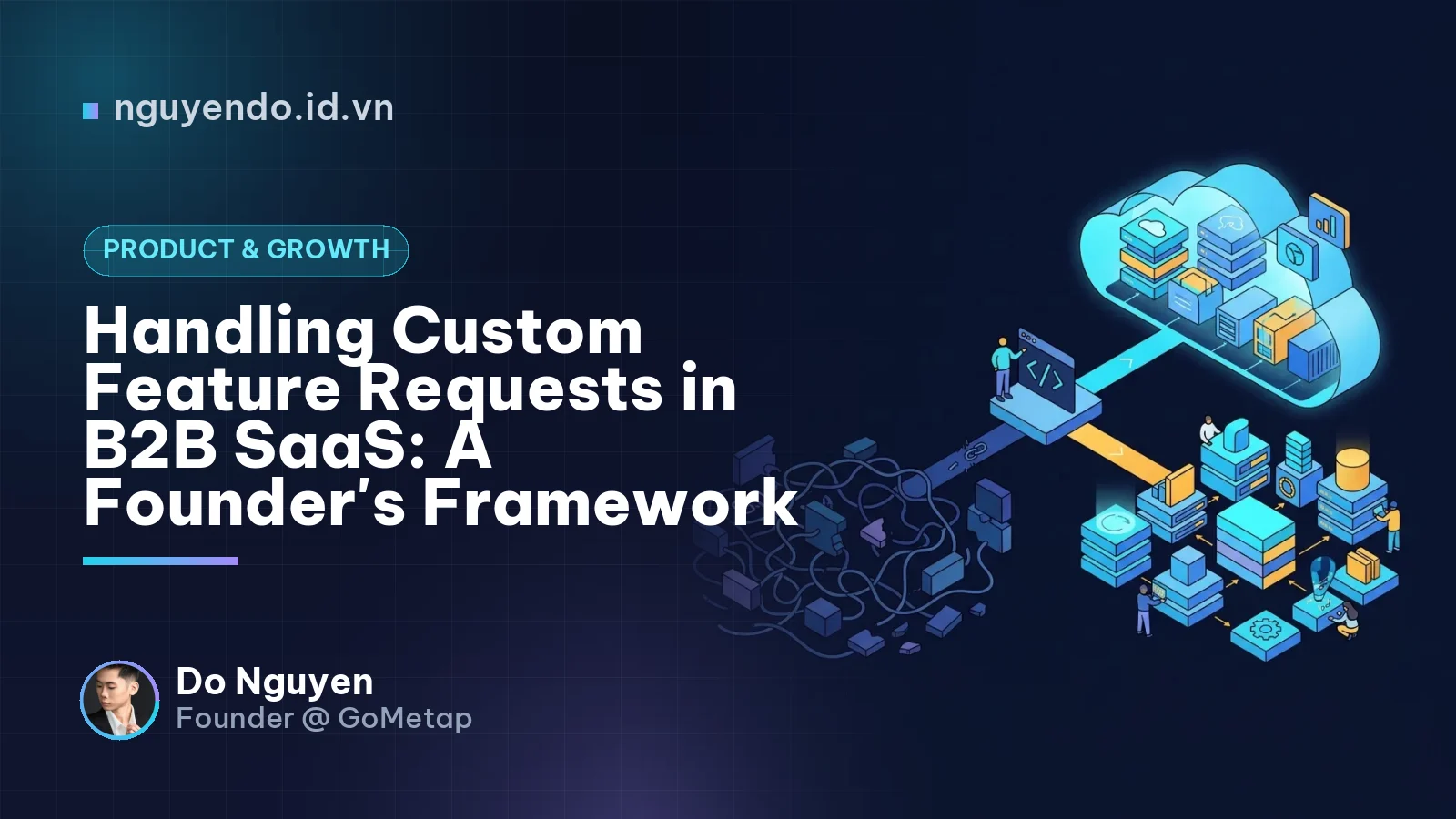
Table of contents
A custom feature request in B2B SaaS is a request from a prospect or customer to build tailored functionality specifically for their workflow. The standard rule for early-stage founders is simple: never build bespoke, proprietary code for a single customer unless that capability aligns directly with your core product roadmap and can be generalized across your broader customer base.
In Southeast Asia and emerging startup ecosystems, enterprise and mid-market buyers routinely demand custom integrations, bespoke reporting, or specialized operational modules before signing a contract. For founders—especially those who transitioned from IT outsourcing or agency services—the temptation to say "yes" in exchange for upfront cash is overwhelming. Doing so repeatedly, however, dilutes your product focus, burdens your engineering team with unmaintainable legacy code, and converts your high-margin SaaS model back into a low-margin professional services shop.
Here is the operational framework we use to evaluate incoming requests, separate structural product requirements from edge cases, and push back professionally without killing high-value deals.
The Real Cost of the "Just This Once" Feature Trap
When a sales lead says, "We will sign an annual enterprise tier if you build this custom approval flow," the revenue looks guaranteed. The hidden liabilities, however, rarely appear on an invoice:
- Maintenance Overhead: Every custom conditional branch or private database field must be maintained across future updates, security patches, and database migrations.
- Roadmap Cannibalization: Assigning two senior engineers to build a custom module for one buyer delays core features that serve hundreds of existing customers.
- Deployment Fragility: Forking codebases or supporting bespoke microservices introduces configuration drift, driving up QA and customer support overhead.
- Valuation Penalty: SaaS businesses are valued on predictable recurring revenue (ARR) with gross margins above 75-80%. Professional services revenue generated from custom development rarely commands software multiples.
When evaluating a feature request, ask yourself: If this customer churns in 12 months, does this feature make our product more competitive in the market, or is it useless technical baggage?
The 4-Tier Evaluation Matrix for Custom Requests
Before rejecting or accepting any product modification, run the customer's request through a structured qualification matrix.
| Classification | Definition | Founder Action |
|---|---|---|
| Core Platform Upgrade | High customer overlap; solves a widespread pain point aligned with your roadmap. | Absorb into the standard product roadmap at no custom fee. |
| Configurable Parameter | A variation of an existing workflow that can be solved via system settings or metadata. | Build flexible configuration settings rather than custom logic. |
| Ecosystem Extensibility | Unique data transfer or tool integration required by specific enterprises. | Expose public APIs or webhooks; let the customer integrate via standard endpoints. |
| Bespoke Legacy Workflow | Highly specific, non-replicable process unique to one organization's internal politics. | Politely decline or recommend third-party integration partners. |
Step 1: Diagnose the Root Workflow, Not the Feature Request
Customers are domain experts in their operational problems, but they are rarely software architects. When an operations director asks for an export button that generates a specific 24-column Excel format, they rarely need that exact button. They need a way to feed clean operational numbers into their legacy enterprise resource planning (ERP) system.
To unpack the underlying requirement, use the "Five Whys" framework in product discovery:
- "Why do you need this custom spreadsheet layout?"
- "Because our regional finance manager imports it into SAP every Monday morning."
- "What fields does SAP reject if they are missing?"
Through this line of inquiry, you discover that the real need is an automated webhook or an integration endpoint, not a hardcoded CSV export tailored to one office's preferences.
Step 2: Leverage Extensibility Over Hardcoded Code
If you build software for businesses, your long-term goal should be modular extensibility rather than custom software delivery. For instance, when we build business infrastructure at GoMetap—such as issuing digital passes for Apple Wallet and Google Wallet—we provide open API hooks, standardized trigger events, and dynamic templates rather than writing custom software wrappers for every distinct retail chain.
If a client asks for customized logic:
- Offer Webhooks: Let their technical team capture transaction events and route them to their internal tools.
- Offer Custom Fields / Metadata: Allow administrators to create custom attributes on records without changing the underlying relational database structure.
- Offer Native Integrations with Automation Platforms: Support Zapier, Make, or native HTTP connectors so non-technical enterprise teams can orchestrate their own custom workflows.
How to Say No Without Losing the Deal
Saying no to an enterprise prospect requires positioning the rejection as a commitment to software reliability, security, and long-term uptime.
"Our architecture is built on a shared, enterprise-grade cloud engine to ensure that your system stays 99.9% reliable and receives weekly security updates. If we hardcode custom changes into your specific environment, we will break your compatibility with future platform upgrades.

While we cannot build this proprietary feature into the core software, here are the two options that achieve your operational goal within our standard architecture..."
Provide viable alternative workarounds:
- The API Approach: "You can use our standard outgoing webhooks to push this data to your internal tool instantly."
- The Roadmap Timeline: "This capability is planned for Q3 as part of our advanced permissions update. We can onboard your team today on the standard tier and grant you early beta access once it launches."
- The Workflow Workaround: "Most of our enterprise clients accomplish this outcome by combining our status tagging feature with automated email summaries."
When Should You Charge for Custom Development?
There is one exception where building custom capabilities makes strategic sense: when a well-funded enterprise customer funds a feature that was already on your 6-month product roadmap.
If an enterprise demands advanced role-based access control (RBAC) or automated bank reconciliation, and you already planned to build it later this year, you can negotiate an accelerated delivery fee or a high minimum contract value (ACV).
Ensure three contractual conditions are met:
- Full IP Ownership: The software IP remains 100% owned by your company; the customer receives only a non-exclusive license to use the platform.
- General Availability: The feature must be designed as a modular capability released to all qualifying tier tiers, not siloed inside a custom deployment.
- No Maintenance SLAs on Custom Logic: The feature must be maintained under standard product warranty and SLA terms, without customer-specific maintenance clauses.
Building a generational SaaS company requires defending your roadmap against short-term revenue that drains engineering velocity. Every line of bespoke code you refuse to write is engineering bandwidth preserved for building scalable, high-margin software.

Comments
No comments yet. Be the first to share your thoughts!