
Product Qualified Leads (PQL): A B2B SaaS Founder's Guide
Learn how to define, track, and convert Product Qualified Leads (PQLs) to build a high-converting product-led sales motion without burning your team.
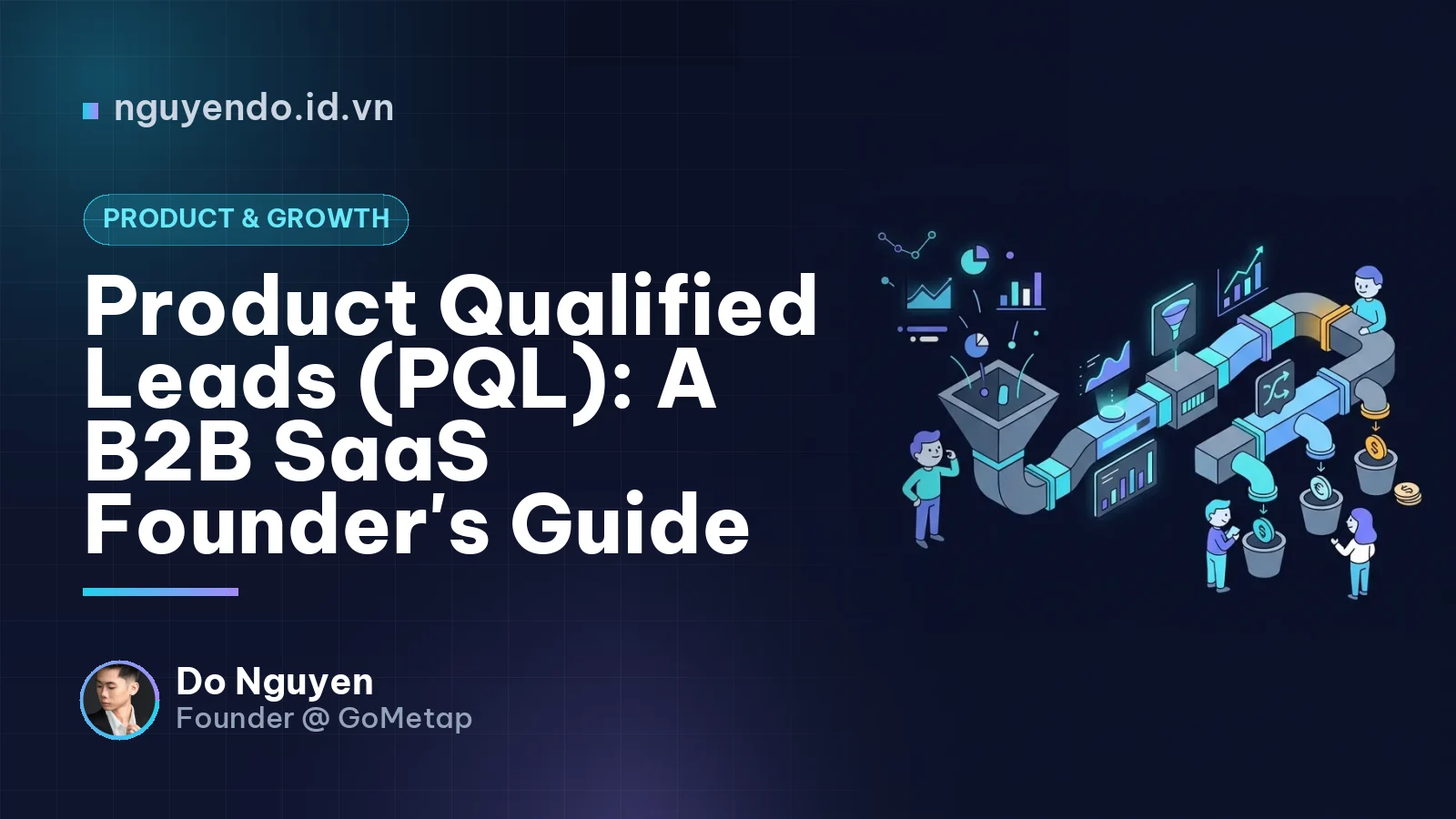
Table of contents
- What Is a Product Qualified Lead (PQL)?
- Why PQLs Are Critical for Regional and Global SaaS
- The 3-Part Framework to Define Your SaaS PQL
- 1. The Value Milestone (Activation)
- 2. Usage Velocity and Breadth
- 3. ICP and Account Fit
- Setting Up PQL Trigger Points: Step-by-Step
- How to Conduct Product-Led Sales Outreach
- Don't Be Creepy, Be Helpful
- Target Account Expansion Triggers
- Common PQL Mistakes Founders Make
- Measure and Iterate
A Product Qualified Lead (PQL) is a user who has engaged with your software through a free trial, freemium tier, or proof-of-concept and crossed specific product usage milestones that demonstrate clear buying intent. Unlike traditional leads based on form fills or content downloads, PQLs allow SaaS companies to prioritize sales conversations with accounts that have already experienced meaningful value, lifting free-to-paid conversion rates to 20% or higher. For B2B founders operating in Southeast Asia and scaling globally, building an automated PQL framework bridges the gap between self-serve onboarding and high-touch enterprise sales.
What Is a Product Qualified Lead (PQL)?
A Product Qualified Lead (PQL) is a prospective customer whose in-app behavior and account characteristics indicate they have reached an activation threshold and are ready for a paid commercial upgrade.
In early-stage SaaS, founders often rely on Marketing Qualified Leads (MQLs)—users who downloaded an e-book, attended a webinar, or signed up for a newsletter. However, MQLs measure curiosity, not purchase intent. Sales Qualified Leads (SQLs) traditionally rely on demographic filters and budget confirmation via discovery calls, which creates friction before a user ever touches the product.
| Lead Type | Primary Qualification Signal | Verification Method | Typical Close Rate |
|---|---|---|---|
| Marketing Qualified (MQL) | Content engagement, website visits | Form submissions, page tracking | 1% – 3% |
| Sales Qualified (SQL) | Budget, authority, explicit timeline | Discovery calls, manual qualification | 10% – 15% |
| Product Qualified (PQL) | Active feature usage, threshold achievement | Real-time product telemetry + ICP fit | 20% – 30% |
When a team sees real operational results inside your software, the sales conversation shifts from defending your value proposition to removing contractual and expansion friction.
Why PQLs Are Critical for Regional and Global SaaS
Building a pure enterprise sales-led motion from Southeast Asia targeting Western markets or enterprise buyers is expensive. Outbound SDR teams and lengthy qualification cycles burn capital rapidly. Conversely, relying strictly on self-serve credit card checkouts often fails when selling to mid-market organizations that require custom invoicing, team permissions, security audits, or bank transfers.
A product-led sales (PLS) model powered by PQLs gives you the best of both approaches:
- Lower Customer Acquisition Cost (CAC): Your product acts as the initial qualification engine, eliminating unqualified sales calls.
- Shorter Sales Cycles: Buyers reach out or respond after they understand the product, compressing evaluation timelines from months to days.
- Accurate Resource Allocation: Your sales reps spend time on accounts already consuming compute, seats, or workflow capacity.
At GoMetap, where we deploy digital operations and loyalty infrastructure across retail networks, we observe this dynamic constantly: a business owner who integrates their POS data or generates their first automated passes is ten times more likely to purchase an annual subscription than someone who simply filled out a demo request form.
The 3-Part Framework to Define Your SaaS PQL
Not every active user is a viable commercial lead. A solo freelancer logging in daily on a free tier may be highly engaged but will never buy an enterprise tier. A healthy PQL definition balances three components.
1. The Value Milestone (Activation)
Identify the single workflow that delivers the "Aha! moment." For an email tool, it is sending the first campaign to 100 subscribers; for an analytics platform, it is installing the SDK and querying a dashboard; for an operations SaaS, it is processing the first live transaction.
Look at historical customer cohorts: What did 80% of retained paid accounts accomplish within their first 7 days? That metric is your activation baseline.
2. Usage Velocity and Breadth
A user who activates a feature once is interested; a team that uses it repeatedly across multiple dimensions is qualifying themselves. Track:
- Breadth: Number of invited team members actively collaborating.
- Depth: Utilization of advanced modules (e.g., automated rules, custom reports, API calls).
- Frequency: Multiple sessions per week across distinct user profiles within the same domain.
3. ICP and Account Fit
Combine behavioral data with firmographic criteria. Even high usage will not yield an enterprise deal if the account lacks budget or team size. Filter accounts by:
- Business email domain (rejecting generic
@gmail.comor disposable domains for automated sales routing). - Company size, sector, and target geography.
- Tech stack compatibility (detected through integration setups).
The PQL Formula:
PQL = Value Milestone Completed + High Usage Velocity + Positive ICP Fit
Setting Up PQL Trigger Points: Step-by-Step
To move from theory to execution, instrument your product to flag sales-ready accounts automatically:
- Define Core Event Tracking: Use tools like PostHog, Segment, or Mixpanel to track critical lifecycle events (e.g.,
member_invited,api_key_generated,threshold_reached_80pct). - Assign Scoring Weights: Give points to high-intent actions. For example, adding 3 team members (+20 points), visiting the billing page (+15 points), hitting 80% of free limits (+30 points).
- Set Up Real-Time Webhooks: When an account crosses the PQL scoring threshold, trigger a webhook directly into your CRM (HubSpot, Salesforce) or a dedicated team channel in Slack or Lark.
- Assign Account Owners Instantly: Ensure qualified accounts are immediately mapped to an account executive or founder before the user's operational momentum cools down.
How to Conduct Product-Led Sales Outreach
Reaching out to a PQL requires a consultative approach rather than a traditional pitch. The user already knows your interface; they need help solving organizational problems or scaling limits.
Don't Be Creepy, Be Helpful
Never open an email saying, "I saw you clicked on the settings page 4 times today." Instead, anchor your outreach to their operational progress:
"Hi [Name], I noticed your team just connected the third store location to the workspace. Most teams scaling past three locations usually look to automate daily reconciliation or set custom role permissions. Would you like a 15-minute walkthrough on how to set up multi-location governance?"
Target Account Expansion Triggers
Watch for paywall collisions. When a workspace hits 85% of its free storage, contact limit, or user seat allowance, trigger both an in-app prompt and a personal outreach from sales offering an extended pilot on the enterprise tier.
Common PQL Mistakes Founders Make
- Overcomplicating the model too early: You do not need machine learning to identify PQLs. Start with 2 to 3 binary operational milestones.
- Neglecting the time decay factor: A user who hit your activation milestone 60 days ago and has not logged in for 3 weeks is no longer a PQL; they are an at-risk churn account.
- Treating free users like leads too soon: Reaching out before the customer experiences product value disrupts their natural onboarding and damages trust.
Measure and Iterate
Track the conversion rate of your identified PQLs into paid opportunities weekly. If less than 15% of your flagged PQLs convert to revenue, your qualification threshold is too low—tighten your usage or ICP filters. If your sales team lacks pipeline while free signups are surging, your criteria are too restrictive.
Treat your qualification threshold as an evolving product feature. Align your product telemetry with your commercial goals, and let real software usage power your SaaS revenue engine.
Comments
No comments yet. Be the first to share your thoughts!